The Stock Can't Trade Yet. Something Is Already Pricing It.
Four synthetic markets priced companies before their shares could trade. Then the cash market arrived—and changed what those prices meant.
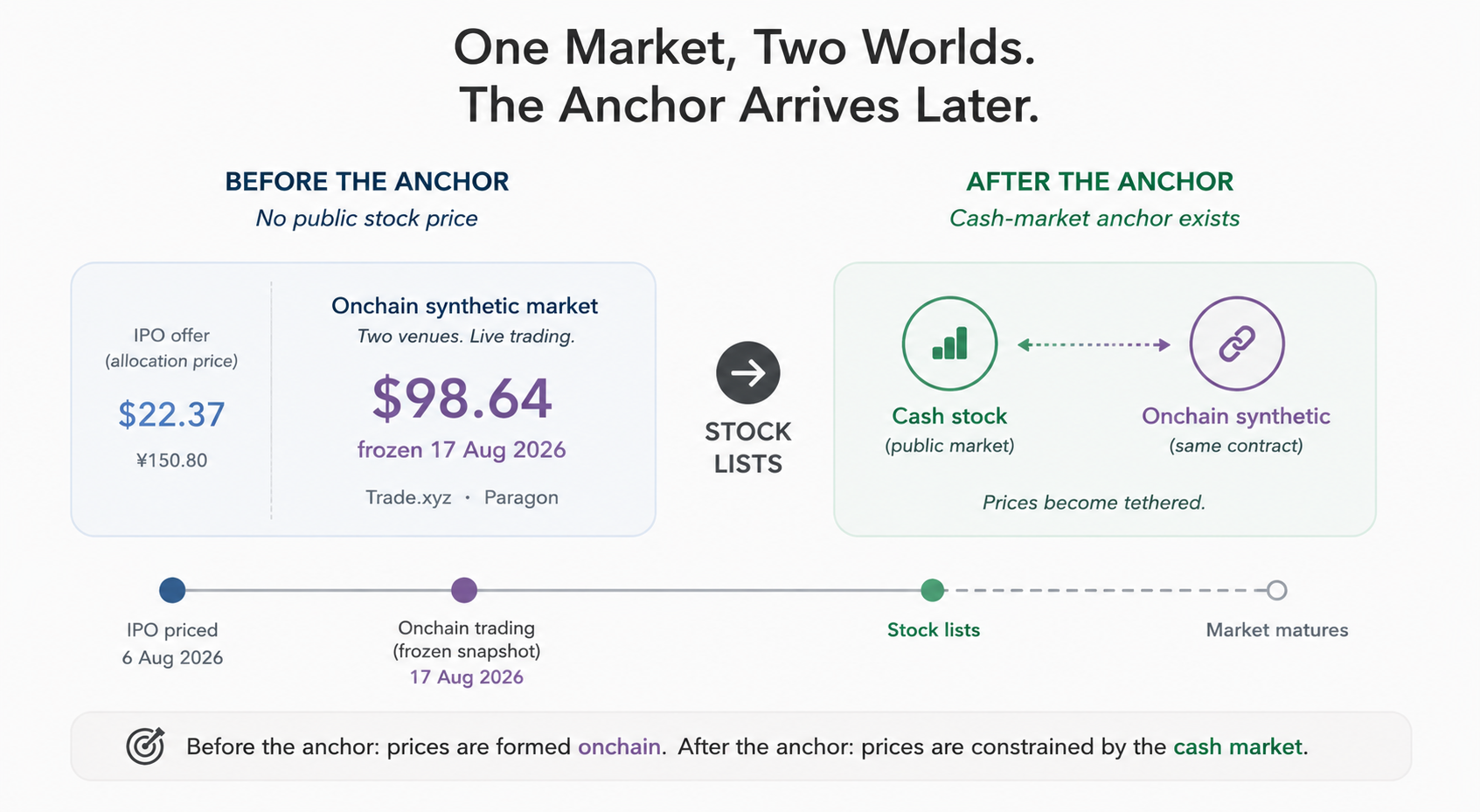
Unitree Technology priced its Shanghai IPO on 6 August 2026 at ¥150.80 a share, about $22.37. The shares began trading on the Shanghai STAR Market on 19 August.
Two onchain venues have been quoting the company anyway. On 17 August I froze the midpoint of their two prices at $98.64 and wrote it to an append-only file, before any listing date existed — so the timestamp cannot be chosen after seeing the outcome. It is not a forecast and not a fair value. It is the price two order books were clearing at.
And they are clearing: nearly every fifteen-minute interval since launch contains trades, with roughly 250,000 open contracts across the two venues, worth about $26 million at their own marks. Their matched prices have differed by a median 1.75%—close enough that $98.64 is difficult to dismiss as an artifact of one book.
At the freeze, what was missing was the thing that normally disciplines a derivative. The shares had not begun public exchange trading, so there was no contemporaneous cash-market price to arbitrage the contract against.
So what anchors a traded price before the underlying stock trades—and what changes once it does? Unitree has now let us watch both regimes. Cerebras, Quantinuum, SpaceX and CXMT gave me four completed cases. Unitree was different: its $98.64 price was frozen before the fifth outcome existed.
What is a price with nothing underneath it?
These are builder-deployed perpetual markets on Hyperliquid — anyone meeting the protocol’s requirements can stand one up — and the venues run them as a distinct contract class for companies that have not listed. One contract references one future share, quoted in dollars, cash-settled.
This is not a tokenized share: a tokenized stock brings the share onchain — custody the equity, mint a claim against it. This market brings the exposure onchain before the share itself has a public market, and no Unitree stock sits behind the contract — holding the perp conveys no ownership, vote, or dividend claim.
A centralized pre-market can offer similar economic exposure before a listing; what’s distinctive here is that the order book, funding regime, leverage cap, and later reference switch are all observable in the onchain venue itself, not inside a broker’s book. With no publicly tradable equity to reference, the venue prices from its own order book, funding runs at one percent of standard, and leverage is capped at five times instead of the usual ten or twenty. Once the stock trades publicly, the venue can convert the contract to an external reference and restore ordinary perpetual mechanics. That transition need not be simultaneous with the cash-market open.
They do not settle on the opening print. At listing they convert into ordinary equity perpetuals and the position continues, so no single moment of the listing day is contractually privileged. To ask where the pre-listing price sat, I compare it against the stock’s first-day VWAP — a description of the valuation region that formed once the cash market existed.
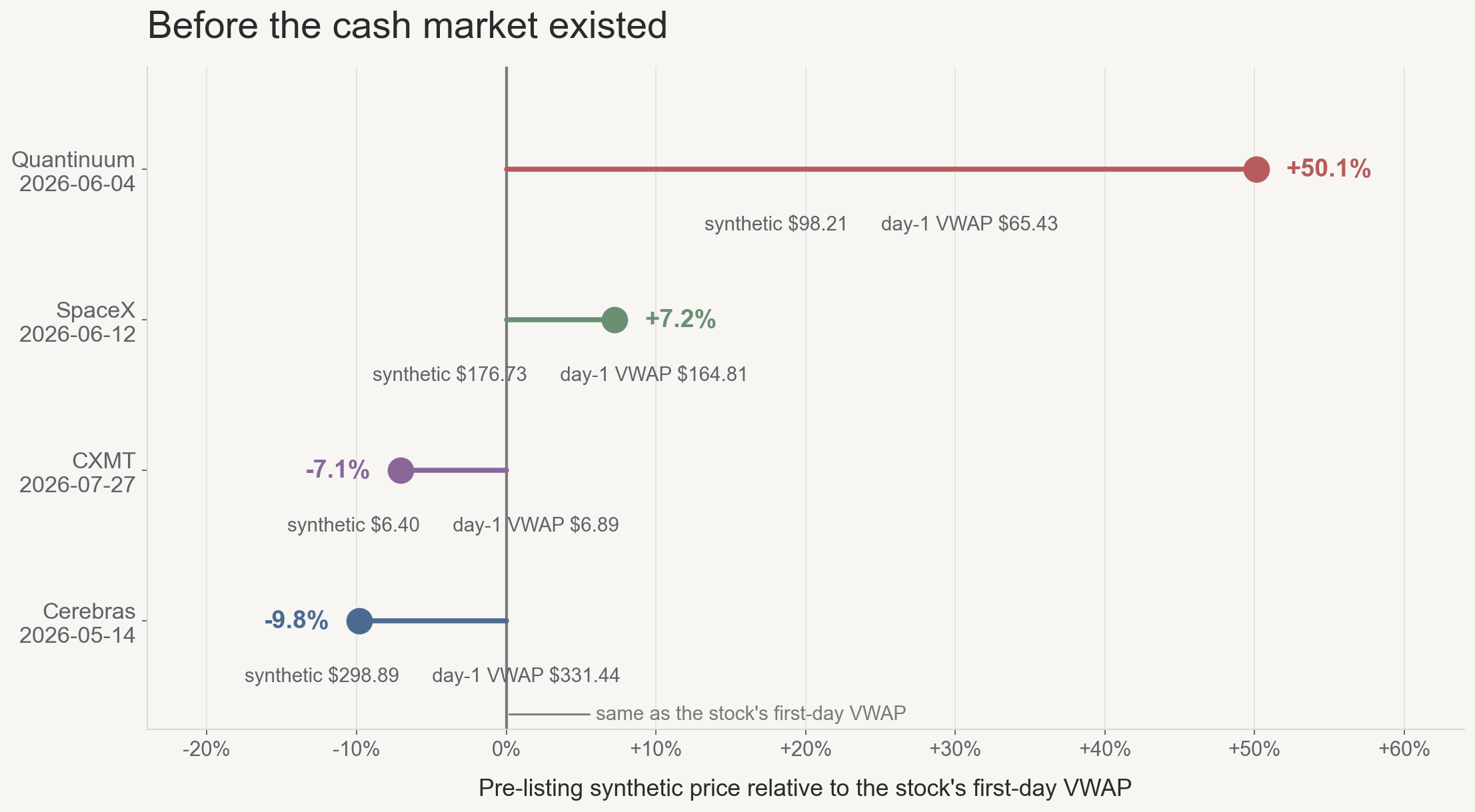
SpaceX cleared 7.2% above the price its stock averaged on day one. CXMT was 7.1% below, Cerebras 9.8% below. Quantinuum was 50.1% above, higher than the stock’s entire first-day range.
A real, continuously traded price can form without a cash-market anchor, and it can land close to the valuation region the public market later produces or nowhere near it. Both come out of the same machinery.
Part of the explanation is who is in the room. The people willing and able to hold a leveraged, cash-settled claim that confers no ownership are not the pool that will price the listed shares — least of all for a Shanghai A-share. Traditional finance has seen this before: European IPOs run grey markets in the days before listing, and the literature reads those prices as the valuation of the clientele that shows up there rather than a universal consensus.
The other part is mechanical — the reference, funding, and leverage choices described above. The venue is therefore doing more of the price formation internally than an ordinary equity perp would.
Trade.xyz runs Unitree’s funding at 0.005 against a 0.5 standard; Paragon runs it at 0.006 against 0.6. Two separate deployers landed on essentially the same one-percent choice.
That is what an unanchored market looks like: its execution and reference machinery are internal, even when the information traders bring to it is not.
When did the price change?
If these markets simply sharpen as their own listing approaches, the largest repricing should arrive at a similar distance from each stock’s first trade.
It did not. The three Nasdaq names opened two hours apart — SpaceX at 15:30Z, Cerebras at 16:30Z, Quantinuum at 17:30Z — and all three put their largest pre-opening hourly move in the same 14:00Z bar. That is 1.5, 2.5 and 3.5 hours before their respective openings.
They did not move at the same point in their own countdown. They moved at the same point on the market clock.
That is a strange thing for these markets to do. They trade continuously — twenty-four hours, no open, no close, no auction — so the contract itself does not privilege 14:00Z over any other hour. The clustering therefore points outside the contract: to trader behaviour, liquidity, or information arriving on a shared external schedule.
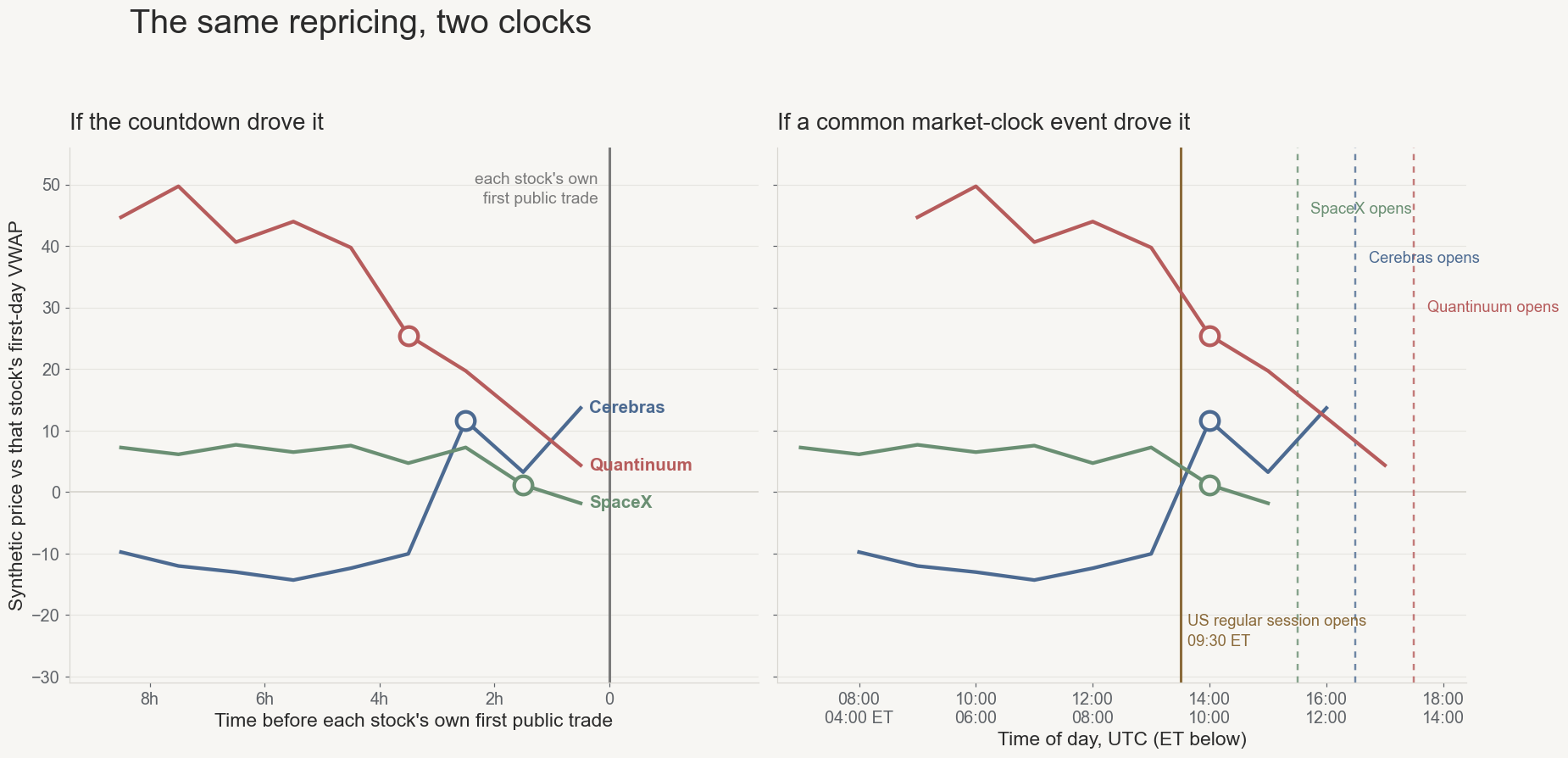
Cerebras shows the texture. Against the price its stock would average on day one, it sat between about 10% and 14% below for six straight hours that morning, drifting and going nowhere. In the 14:00Z bar it went to 11.6% above, on roughly forty times the hourly volume it had been trading. Quantinuum’s book did the same thing in the same hour, at over a hundred times its prior volume.
So a simple fixed-distance countdown fits these three cases poorly. It does not tell me what happened at 14:00Z.
Nasdaq’s opening process for each of these IPOs runs somewhere inside that window, publishing an indicative clearing price to anyone with the feed. Without the historical indicative series, though, the evidence so far identifies the clock, not the mechanism.
SpaceX gives one direct look at the mechanism. Nasdaq entered its quoting-only state at 09:50 ET and began publishing indicative prices; during the same 10:00–11:00 hour as the onchain break, that indication fell from $175 to $162 while the synthetic fell from $176.76 to $166.72. The clocks line up and the direction matches, though the hourly onchain data cannot establish minute-level ordering or causality.
My conjecture: these markets borrow more than the clock of the market that will eventually anchor them — they also borrow its information and risk-bearing capacity. Before listing, the synthetic price is set by whoever is willing to hold exposure that cannot yet be directly hedged against the listed share. When the US trading day gets going, the set of marginal traders can change — market makers are active, common opening information arrives, and uncertainty about the coming cash price falls. A market can therefore trade twenty-four hours a day while meaningful price discovery still clusters around institutional hours. SpaceX is consistent with that story. The other two cases cannot separate information from risk-bearing capacity, but their timing suggests an always-on market can still inherit the institutional rhythm of its eventual anchor.
What changed when the stock arrived?
The simplest theory of these markets is that they exist because the stock cannot be bought yet, which would make listing the end of them.
It was not. Across all four completed cases, onchain activity in the week after listing ran between 1.9× and 11.6× its pre-listing level. Activity is not the same thing as liquidity, and none of it says where anyone’s capital came from — but the markets plainly did not empty out.
What changed was the plumbing, and it changed on the venue’s own configuration. The funding multiplier went from 0.005 back to the standard 0.5 — the tether was switched from one percent strength to full. The reference price stopped being derived from the contract’s own order book and started coming from an external index built on the listed share. Leverage caps rose from five times to ten or twenty. The contract that had been trading without a cash-market anchor became tightly linked to one, and it kept trading throughout.
The prices show it. For the three US names, the median signed gap between synthetic and stock settled inside a tenth of a percent. Before listing there was no publicly tradable share price to trade against; after listing there is, and somebody with access to both can close the difference.
CXMT is the exception that keeps this honest. Its synthetic price has settled at a persistent discount of roughly 3% to the Shanghai shares — one-sided, not noise, and not explained by the currency conversion. An anchor can exist without producing a tight relationship, which is what stronger segmentation between two sets of traders would look like.
All of that is visible in the venue’s own registry rather than inferred, which is one of the more useful things about doing this onchain: the contract tells you which regime it is in.
Closing
Which returns us to $98.64.
On 17 August that was an unanchored clearing price — what a particular set of traders, whoever could reach a leveraged synthetic claim on a Shanghai listing, would transact at, with no publicly tradable cash-market price to check it against.
Unitree opened at ¥1,100, but that auction print proved extreme: the stock fell as low as ¥800.08 and closed at ¥845. Its first-day VWAP was ¥902.63, about $133.88. Against that more representative benchmark, the frozen $98.64 price was 26.3% low — the largest negative miss in the five-case sample.
The cash market had one opening bell. Onchain, the anchor arrived twice. The two venues did not convert together. Trade.xyz switched its funding multiplier from 0.005 to the standard 0.5, and its leverage cap from five times to ten, at 02:11 UTC — 41 minutes after continuous trading opened. Paragon made the identical switch 71 minutes later, at 03:22 UTC. The basis moved with them: at the instant Trade.xyz converted, its mark price sat within 0.5% of the concurrent stock price, as tight as anything observed in the three Nasdaq cases; by the time Paragon converted, the gap had already widened to 6.2%. By the close, both venues’ traded marks sat roughly 8% below the stock — but the external index each had just switched onto, the reference funding now pulls toward rather than the price actually trading at, stayed within 2%.
One day of data does not settle whether that gap closes the way it did for the three Nasdaq names or persists the way CXMT’s has. The reference switched in one transaction. The market did not.
Appendix
- Data. Archived Hyperliquid public API data (prices, volume, contract settings) for Trade.xyz and Paragon. Completed sample: Cerebras, Quantinuum, SpaceX, CXMT.
- SpaceX opening-information series. Reconstructed from Nasdaq’s own historical TotalView-ITCH data.
- Unitree freeze. $98.64 cross-venue midpoint frozen 17 August 2026, before any listing date existed.
- Reproducibility package: gist.github.com/egpivo/82f3b16d30504b3e5accdaa3f5245f86.
- Related: The SpaceX Trade Exists. Now Watch the Tape..