What Changes When Tokenization Reaches Market Scale?
Korea is not stopping at a deposit-token pilot. The stated direction is to register securities — funds, bonds, then stocks — on a distributed ledger.
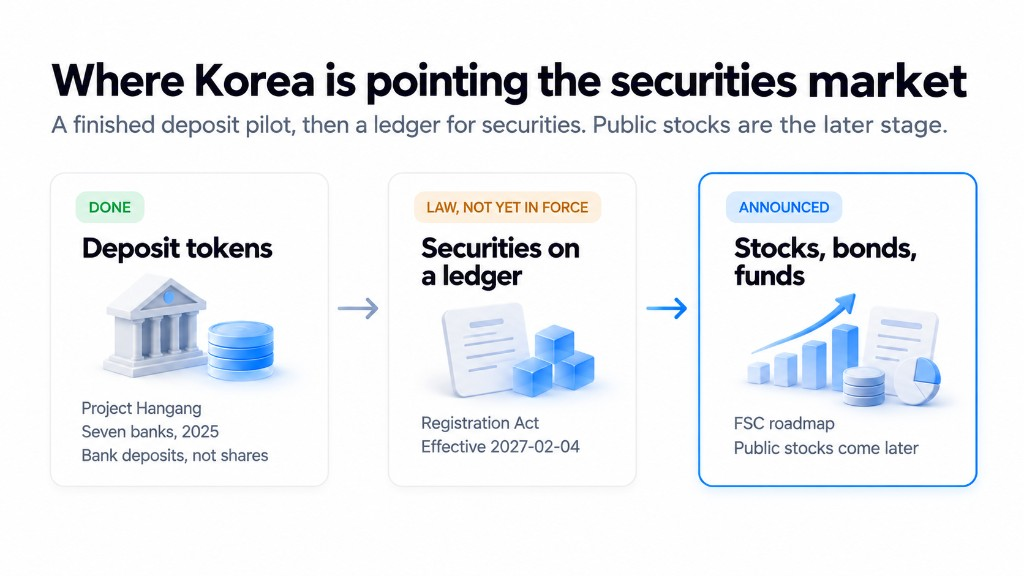
Project Hangang’s Phase-I pilot ran for three months in 2025. Seven banks processed real transactions over a 20-node permissioned network. The pilot opened 81,000 wallets and converted roughly KRW 1.64bn from deposits into deposit tokens. That is bank money on a closed network, not the stock market. The pilot’s own report says neither number was a success criterion.
I argued earlier that the useful question is infrastructure — custody, collateral, settlement — not the token format. Here the infrastructure question is concrete: what changes if the thing being registered is a share, a bond, or a fund, not a pilot deposit.
1. A pilot proves capability. Scale changes the question.
Project Hangang’s Phase-I report confirms specific technical capabilities:
issuance, conversion back to deposits, merchant payment, interbank
burn-and-issue settlement, forced conversion at pilot end, and programmable
voucher processing. Those are real, observed operations — OBSERVED PILOT,
not a claim about market demand. The report itself states that wallet
counts and converted value were not success criteria, and it publishes no
transaction-count series suitable for measuring demand. The pilot is an
operational result, not a demand result.
Hangang sits alongside a broader institutional trajectory. The FSC’s
September roadmap (ANNOUNCED / POLICY) extends tokenization to
institutional private MMFs and bonds, unlisted stocks through a trust
structure, and publicly offered fractional securities, with broader public
securities left to later, conditional phases. The Electronic Registration
Act amendment creating a legal basis for distributed-ledger securities
registration was promulgated on 2026-02-03 but does not take effect until
2027-02-04. BOK-Wire+, Korea’s conventional RTGS system, had its operating
hours extended from 17:30 to 20:00 effective 2026-03-30 — live conventional
settlement-timing modernization, not a DLT deployment.
- Project Hangang Phase I —
OBSERVED PILOT(complete). Real-transaction pilot, bounded scale. BOK Phase-I pilot report. - Electronic Registration Act —
ENACTED_NOT_EFFECTIVE. Promulgated 2026-02-03, effective 2027-02-04. Korean Law Information Center. - FSC securities roadmap —
ANNOUNCED / POLICY. Phased; later stages conditional. FSC roadmap. - BOK-Wire+ hours extension —
LIVE(conventional). 17:30 → 20:00, effective 2026-03-30. BOK-Wire+ release.
2. Scaling changes more than throughput.
A stock market is not a faster version of the pilot. Trades are matched, then netted, so many gross obligations become a few net ones before cash and securities actually move. New holders create new records. Trades between people who already hold the stock update old ones. Those two operations do not cost the same. And there is a clock: how long until settlement is final.
More capacity can move the bottleneck. It does not remove it. A system that is cheap for three months of deposit tokens is not guaranteed to stay cheap, or to have the same bottleneck, when the workload is the securities market.
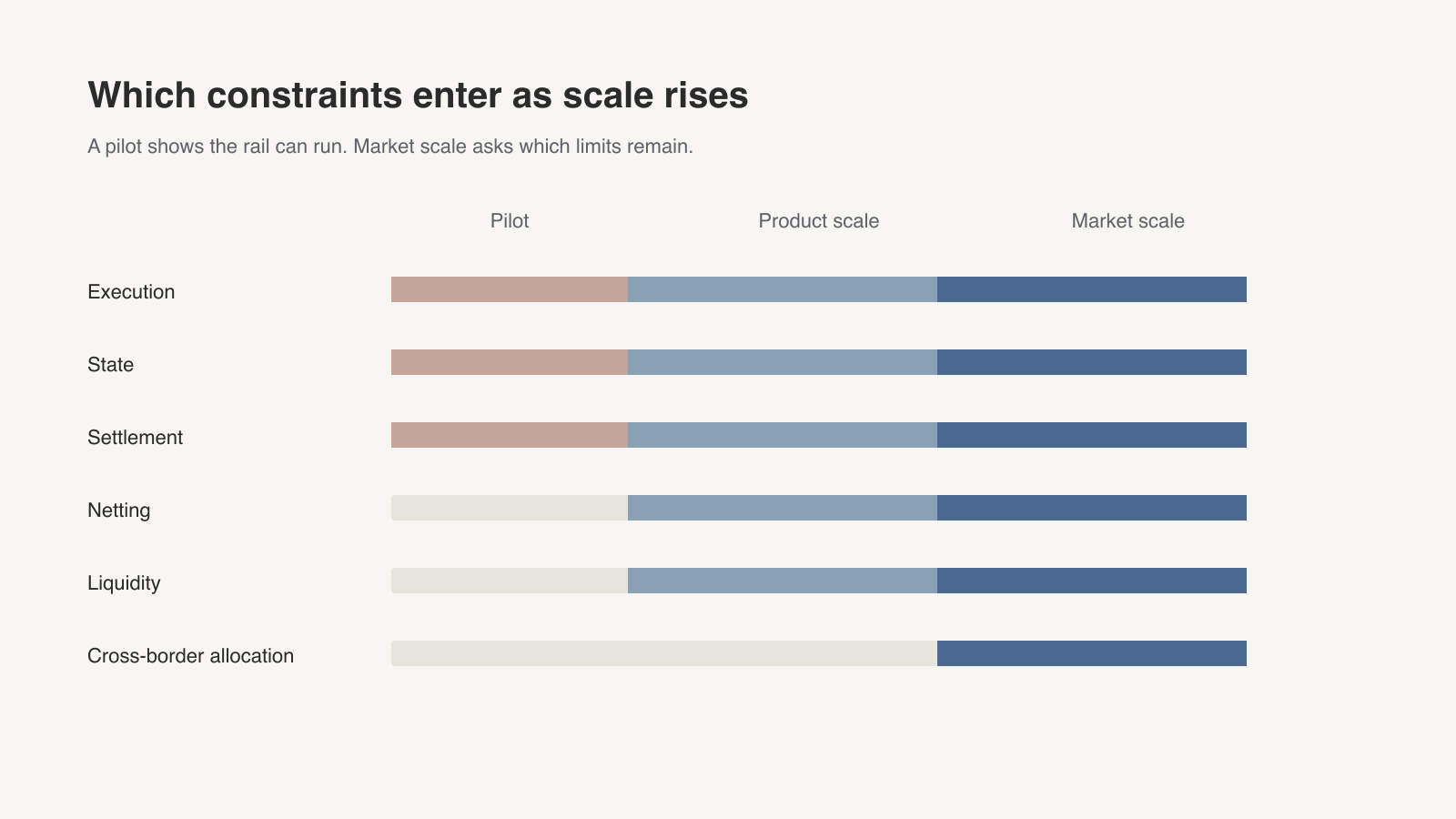
That split is already visible in blockchain engineering: execution capacity and the cost of new state are separate constraints. Ethereum is the example, not a Korean result. A proposed upgrade, commonly called Glamsterdam, is in devnet testing, with no confirmed mainnet date. Part of the test is a higher block-gas ceiling together with a cost schedule that makes brand-new ledger state much more expensive than updating state that already exists. Capacity and the cost of a new record can move in opposite directions. This article does not measure which one would dominate for a KRX workload.
3. Why Korea is a useful market-scale case.
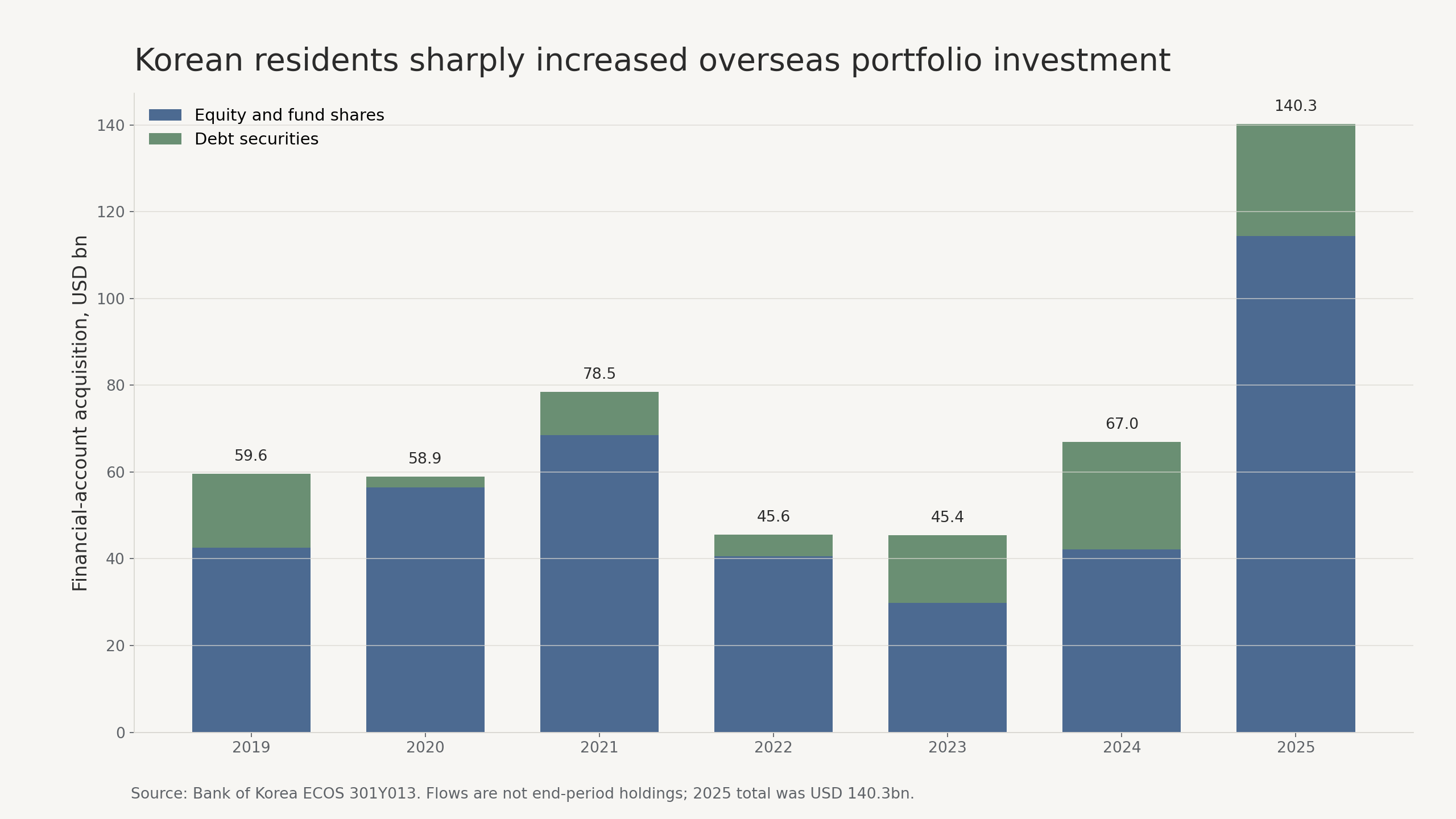
Korea is a useful case because a programmable securities rail would not arrive in isolation. Residents already allocate large portfolios abroad, and a fiat-to-digital-asset interface is already large and older than Hangang.
In 2025, Korean residents added USD 140.3bn in overseas portfolio investment — 7.5% of GDP, more than double the prior year’s ratio. BOK balance-of-payments data show this flow rising from USD 59.6bn in 2019 to USD 67.0bn in 2024 to USD 140.3bn in 2025, equity-led (USD 114.3bn in equity and investment-fund shares against USD 25.9bn in debt securities). The corresponding stock — the accumulated international-investment-position portfolio — reached USD 1.253tn at end-2025.
Korea also already has a material fiat-to-digital-asset interface, separate from and older than Project Hangang. The official VASP survey reports average daily trading value of KRW 5.4tn in 2025H2 and KRW 8.1tn held in exchange KRW deposits. Reported gross external outbound digital-asset transfers reached KRW 107.3tn in 2025H2. That is not capital flight or stablecoin dollarization. The survey counts gross movement across wallets and reporting categories, and it does not identify the asset, the beneficial owner, or what the funds were used for.
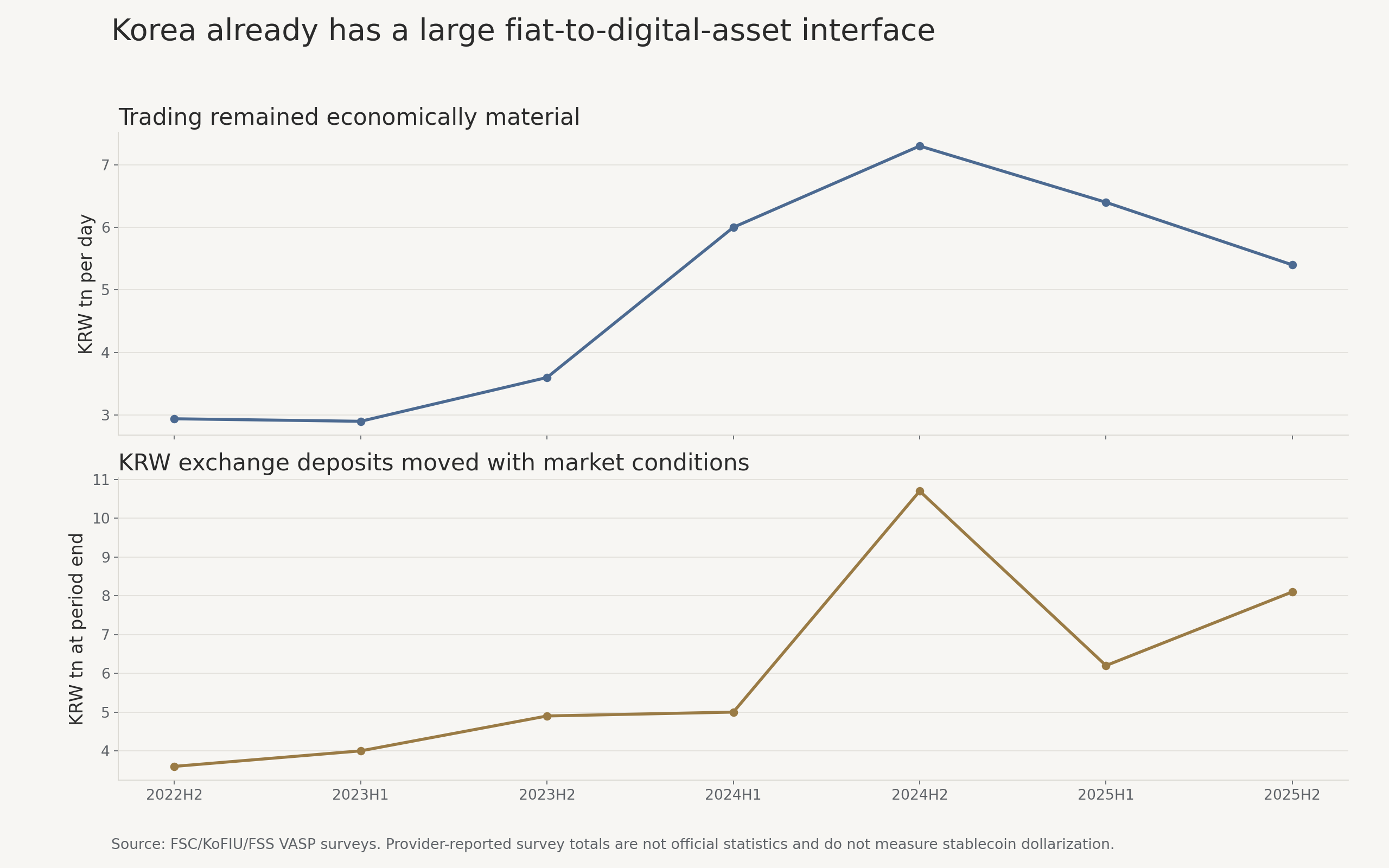
Capital is already mobile. The question is what changes if domestic issuance, ownership records, and settlement become programmable on top of that—and then have to carry a securities-market workload, not a three-month deposit pilot.
Closing
The public record says where this is aimed: securities on a ledger, with listed stocks in a later stage. It does not say whether the stock market’s settlement workload fits there, or what remains expensive once it does. Tokenization does not remove constraints. It changes which one binds.
Appendix
Sources. Institutional-status links appear inline in Section 1. BOK balance-of-payments series and official VASP survey series underlie the figures in Section 3.
Status labels. OBSERVED PILOT — a real, completed operation with no
claim about market demand. ANNOUNCED / POLICY — a stated roadmap stage,
not a live market. ENACTED_NOT_EFFECTIVE — law promulgated, not yet in
force. LIVE — operating today, conventional infrastructure unless noted
otherwise. OBSERVED — a sourced figure, not a model output.