Staked ETH Beyond Staking: Liquidity, Collateral, and Credit
Contents
- The Base Mechanism: A Bond and a Job
- Three Questions About Staked ETH
- What If the Capital Provider Cannot Run a Validator?
- What If the Holder Needs Liquidity Before Withdrawal?
- What If the Holder Needs Liquidity Without Selling?
- Different Capital Structures Around Staking
- Closing: When Do Collateral Liquidity and Redemption Liquidity Become Interdependent?
- Appendix: Sources and Data
How staking separates capital from operation—and creates new routes to liquidity and credit.

This is not only a historical question. In 2026, staking infrastructure is becoming more modular. Lido V3 introduces stVaults, allowing users to define validator arrangements while retaining optional access to stETH liquidity. As staking positions become more configurable and increasingly connected to DeFi, the relationship between operational control, collateral value, and redemption becomes more relevant. The 2022–2023 episode provides a historical stress case for examining these mechanisms.
The Base Mechanism: A Bond and a Job
Ethereum asks validators for two things. The first is capital: ETH posted as a bond, part of which the protocol destroys if the validator commits a provable violation. The second is work: staying online and attesting to blocks. In return, validators earn rewards.
A solo staker supplies both and keeps the whole reward, but the ETH has to come from someone who also runs the machine.
Under stress, the market price of the claim, its collateral valuation, liquidation capacity and redemption queue may no longer move together. The sources document these parts separately and none documents the sequence, so that is a conjecture, and the last section keeps it as one.
Three Questions About Staked ETH
What If the Capital Provider Cannot Run a Validator?
Lido's pooled staking is one way. Depositors send ETH to the pool and receive stETH; Lido's node operators run the validators. The pool takes a fee set by Lido governance and passes the rest to stETH holders.
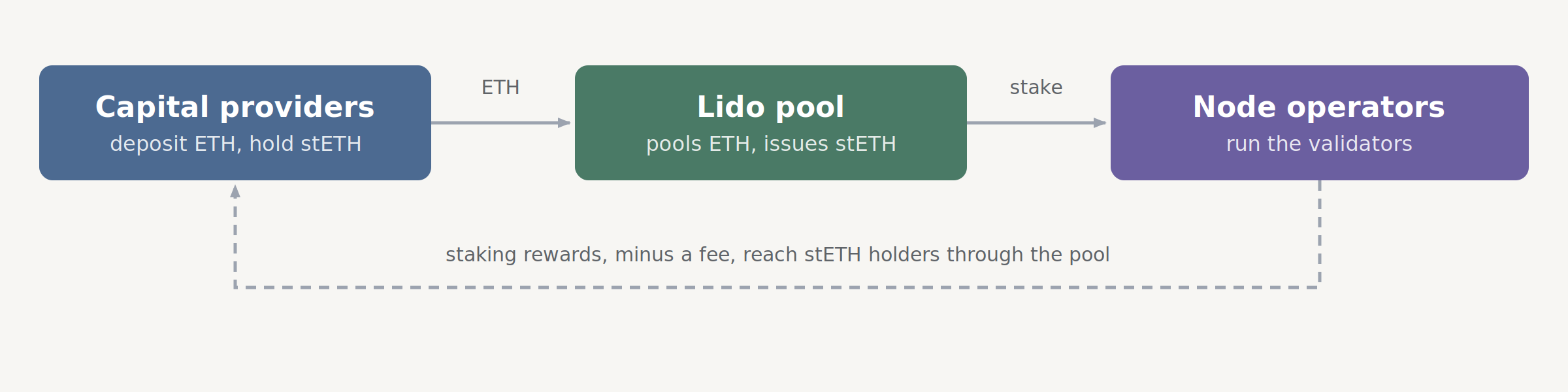
The depositor pays the fee and still bears shared validator penalties.
What If the Holder Needs Liquidity Before Withdrawal?
A holder can request withdrawal but cannot necessarily redeem immediately.
A buyer gets staking exposure without running a validator. If the buyer later requests protocol redemption, the relevant withdrawal queue applies. The price is set in a secondary market, so a holder who sells instead of waiting can get a discount or, at times, a premium to redemption value (Lido, Ethereum).
What If the Holder Needs Liquidity Without Selling?
Selling stETH ends the staking exposure and its rewards. Borrowing against it keeps both.
Earning yield does not automatically make an asset acceptable collateral. A lending market also needs a reliable way to value the claim and enough liquidity to sell it if the borrower defaults. Aave allows wstETH as collateral on its Ethereum Core/Main market, with limits such as a deposit capacity. wstETH is the non-rebasing wrapper of stETH, so a holder can borrow another asset while retaining staking exposure. The amount that can be borrowed depends on how the market values the collateral.
The borrower pays interest and faces liquidation if the collateral no longer supports the debt.
Different Capital Structures Around Staking
Fig. 2 compares three staking arrangements across three questions: who operates, how to exit, and how financing enters. Each product is viewed from the role of its named participant.
StakeWise and Rocket Pool are omitted for clarity; see Appendix. Dashed markers indicate interpretations. Exit routes may coexist, and axis positions are categorical, not scores.
Take Lido's stVault and Frax's ValidatorPool. Both add financing around staking, but for different participants and purposes. A stVault owner, a capital provider, mints stETH against over-collateralized vault ETH, a token liability whose capacity is set by the reserve ratio. A Frax pool owner, a validator operator, draws ETH credit from a lending pool at a borrow rate (24 of 32 ETH in anonymous pools), with the pool owner responsible for validators. The stVault owner instead chooses the node operator.
Closing: When Do Collateral Liquidity and Redemption Liquidity Become Interdependent?
This is a conjecture: the sources document separate steps, none documents the sequence, and one liquidation need not force a validator exit, nor a discount trigger more liquidations.
Suppose many holders have borrowed against staked ETH and a market shock forces liquidations. Liquidators receive the collateral and may need to sell it. If buyers cannot absorb the sales, the token can trade at a deeper discount, while Lido's queue is FIFO. Its risk framework says many holders redeeming at once "can strain liquidity and slow withdrawals."
What Happened in 2022–2023? Fig. 3 shows when the price and the liquidations moved, not why. Curve's daily average stETH price fell to 0.936 ETH on 18 June 2022, and Aave V2 liquidations of stETH collateral seized 2,192 stETH across 82 events on 13 June 2022. The largest single day came later: 4,567 stETH in one liquidation on 17 March 2023, at a price of 0.997 ETH. Validator withdrawals opened on 12 April 2023 and Lido's on 15 May 2023, and from February 2023 the daily price had stayed within 0.6% of par. The daily average does not capture the price at the moment of each liquidation.
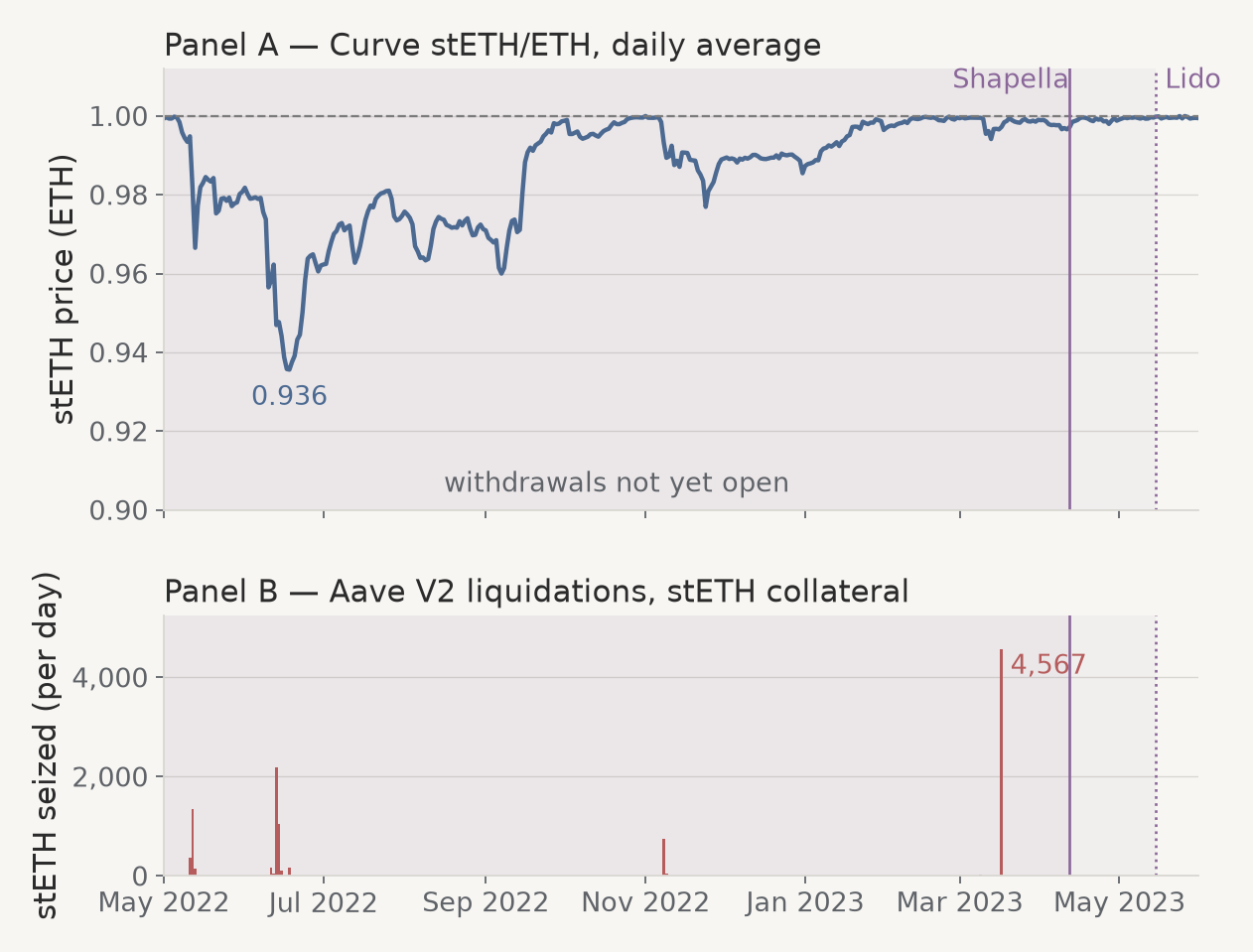
Stress does not always become a cascade, and how collateral is priced is one reason. Aave's 2023 proposal describes the old stETH feed as stETH/ETH, "based on secondary market", so in 2022 a discount could reach collateral value and liquidations. In June 2023 Aave replaced that feed with an exchange-rate-based price, so a stETH market discount no longer moves Aave's collateral valuation directly for the stETH/wstETH feed that change covers. Its authors describe the wstETH change as removing an "undesired exposure to stETH secondary market price". My reading: the pressure then shifts to how much selling liquidators' capital can absorb, and to the exit queue. The risk does not vanish: ETH/USD declines, debt value, liquidation thresholds and position structure still move health factors, so the design changes how risk is transmitted, not whether it exists.
The interaction would be limited if collateral values remain insulated from secondary-market prices, liquidation sales can be absorbed without significant price impact, and redemption demand can be met without materially extending the withdrawal queue.
Staked ETH is not simply liquid or illiquid. Its liquidity depends on which route a holder needs: selling the claim, borrowing against it, or redeeming the underlying asset.
These routes give different forms of flexibility. A market discount, a collateral valuation, a liquidation and a withdrawal queue do not necessarily respond at the same time or in the same way.
The design question is therefore not just how to make staked assets more liquid. It is how to prevent the mechanisms that provide liquidity from becoming constraints on one another when market conditions deteriorate.
Appendix: Sources and Data
Product Documentation
Protocol documentation: Ethereum · Lido · StakeWise · Frax · Rocket Pool · Aave.
Fig. 2 Classification Notes
Categories, not scores. Dashed markers indicate interpretations. The dashed Queue marker represents the inferred Frax redemption route; the inferred stVault market route is not plotted.
Supplementary: StakeWise osETH is Chooses operator (inferred), Market and Queue; Boost exits by unboost through the validator exit queue, not the market; osETH collateral eligibility is unresolved between the Boost docs and Aave. Rocket Pool rETH is Market and Buffer-dependent, Borrow against claim. Aave reserve snapshots (2026-10-29): wstETH 79%, rETH 75%. Frax: 24 of 32 ETH in anonymous pools; whitelisted pools can differ (the v2 page says up to 31, the technical-details page hedges it).
Fig. 3 Data and Methodology
Ethereum mainnet logs, 1 May 2022 to 31 May 2023 (blocks 14,688,661 to 17,382,264), from a public archive RPC (Tenderly), frozen as 98 raw files with a SHA-256 each in data/manifests/steth_window_2022-05_2023-05.json. Events: TokenExchange (Curve stETH/ETH pool), LiquidationCall (Aave V2 LendingPool, stETH collateral), Chainlink ETH/USD for USD value, and the first WithdrawalRequested (Lido withdrawal queue). Dates: Shapella announcement · Lido V2 launch.