How CoW Protocol Uses Auctions to Execute Onchain Trades
CoW does not simply route a swap. It batches trades and auctions execution to competing solvers.
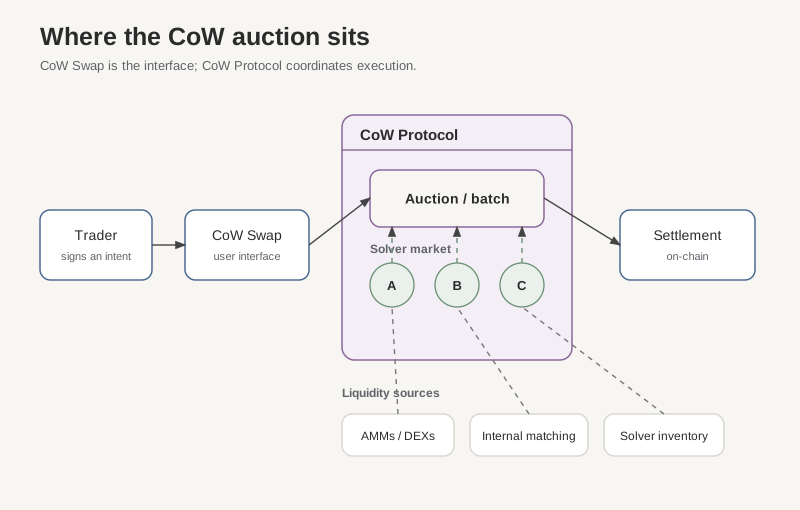
A trader submits an ETH-to-USDC swap. Moments later, one transaction settles on-chain. To the user, it can look like any other routed DEX trade.
With CoW, the swap enters an auction before it settles.
Behind a CoW trade, independent solvers can reach the same auction through different execution paths: an AMM route, a multi-venue route, internal matching, or inventory.
Most DEX users never see discarded alternatives. CoW’s auction archive makes part of that hidden process visible.
That makes CoW useful to inspect now because the mechanism is still being tuned. The DAO changed its consistency-reward metric, has a draft quote-competition redesign, and is preparing a Solana deployment.
There’s an auction behind a swap
CoW Protocol is intent-based: rather than choose a route, a user states what to sell, what to buy, and a limit. CoW then seeks a valid settlement.
The name comes from “coincidence of wants.” If one trader wants to sell ETH for USDC and another wants to buy ETH with USDC, their orders may partially match directly. The unmatched residual can go to external liquidity.
Batching changes the problem. A router usually considers one swap; CoW can consider a group of orders together. Some flow may cross internally, with the remainder sent through pools, DEXs, or other liquidity sources.
CoW Swap collects the intent; the protocol’s solver market searches for settlement.
How a CoW auction actually works
After users submit orders, they enter a batch auction. It is not quite like eBay, where one buyer keeps raising the price until they win. It is also not a Dutch auction, where a price starts high and falls until someone accepts it.
A closer analogy is procurement. Imagine a company that needs several packages delivered. Different logistics companies submit plans: one may handle every package, another may offer the best deal for two, and a third may combine its own trucks with subcontractors. The company can combine compatible offers instead of choosing one carrier for everything.
CoW works similarly. Suppose a batch contains two orders:
Imagine a batch with two relevant intents:
- Alice wants to sell ETH for USDC.
- Ben wants to buy ETH with USDC.
Several solvers try to complete these orders before the deadline:
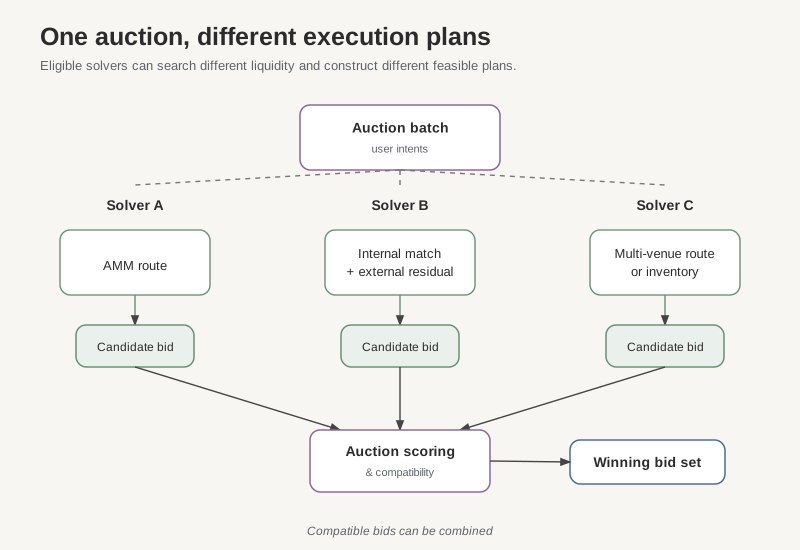
- Solver A routes Alice’s ETH through a Uniswap pool and handles Ben’s order separately.
- Solver B matches part of Alice’s order directly with Ben’s, then uses an external pool for the remainder.
- Solver C combines several venues or uses its own inventory.
For example, if Alice is selling 10 ETH and Ben wants to buy 6 ETH, Solver B may match 6 ETH between them and route only Alice’s remaining 4 ETH externally. Solver A may route all 10 ETH externally instead. Solver C may offer a better result for one order but be unable to handle the other.
These are not just competing prices. They are different plans for completing one batch of orders.
CoW’s Fair Combinatorial Auction can receive proposals for individual orders and for groups of orders. It filters a group proposal if it would leave an order worse off than an available standalone proposal, then selects compatible proposals for the final settlement.
Open one real auction
The mechanism becomes easier to understand when you stop looking at it as a diagram and inspect one order.
The example below is a USDC–WETH sell order in auction 12762284: eight responses, two within 2 bps of the best, and a 22.84-bp best-to-worst gap. The deterministic selection rule is in the Appendix.
Rank the eight solver responses by how far they sit behind the best observed response:
0 → 0.16 → 2.56 → 7.34 → 15.63 → 15.70 → 17.46 → 22.84 bps
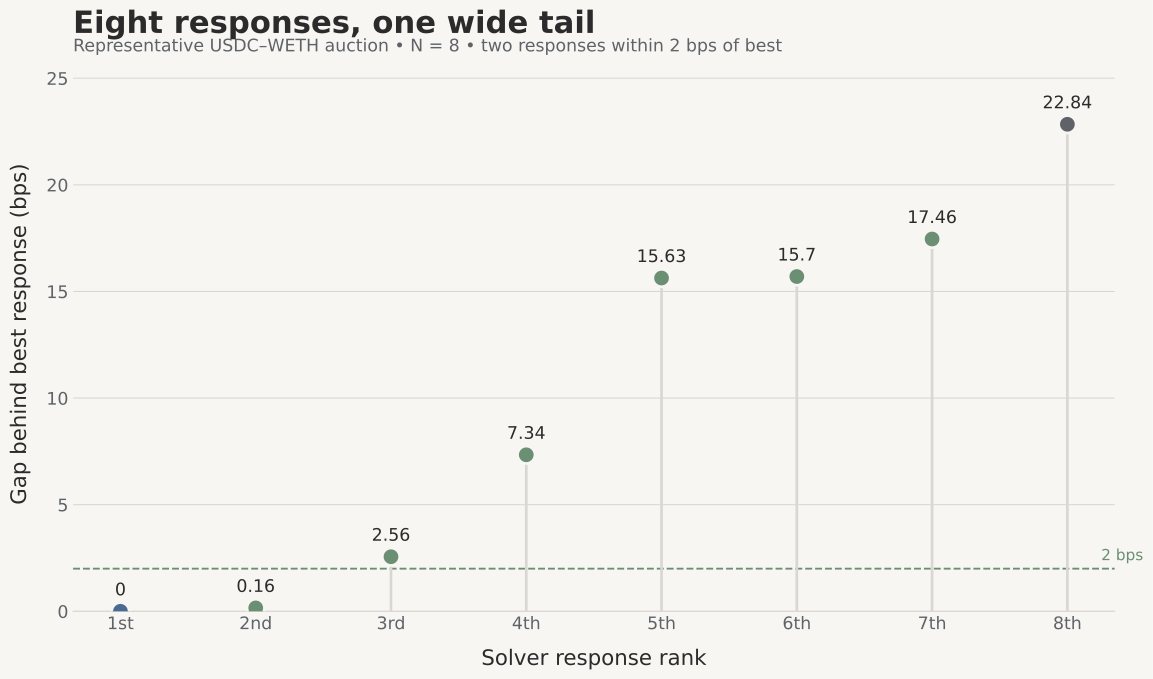
The first two responses are close. The rest spread out quickly.
That does not make the last solver “bad.” It may have used a different route, faced different liquidity constraints, or built a plan that was useful elsewhere in the batch but weak on this order. The narrower point is that a solver count alone does not describe the shape of the submitted answers.
What the comparison samples show
The primary comparison sample contains 46,860 comparable order-level observations across 10 token pairs, with 33 unique solvers appearing at least once. Sample A is the primary historical window; Sample D is a later replication window. Both retain DIRECT-comparable, sell-kind response sets on the same executed slice of an order.
The median comparable order in Sample A has 8 solver responses. The middle half has between 4 and 11. A later replication window, Sample D, has a median of 11 responses.
This is not the whole market. In a broader primary panel of 73,259 eligible auction–order opportunities, only 64.6% received at least two distinct solver responses; 58.3% received at least three. Many eligible opportunities never form a deep response ladder.
The leading responses can still be close when a ladder does form. In Sample A, the median gap from the best response to the second-best is only 0.89 bps. The median gap from best to worst is 22.7 bps. In 61.8% of comparable orders, the best-to-worst gap exceeds 10 bps.
Sample D shows the same broad shape at different levels: 0.60 bps from best to second-best, and 13.8 bps from best to worst. This is directly observed; it does not tell us why a given solver was far behind.
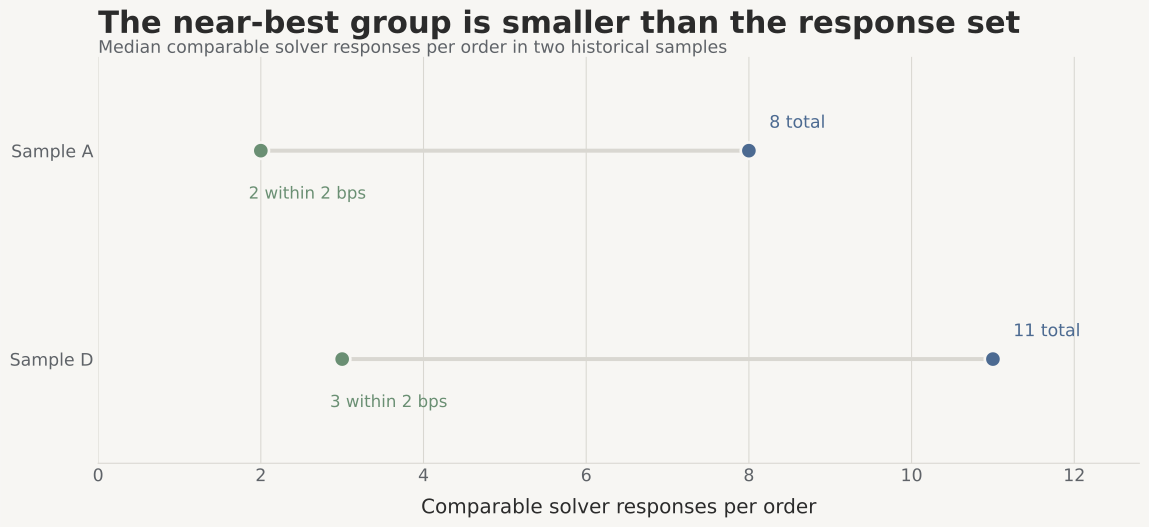
Headcount can hide much more than that average suggests. A separate, one-week validation slice held the response count within 10–12 solvers. Its thin near-best group had 9.1% of responses within 2 bps; its dense group had 100%. Pair and size composition differs across them, so this does not identify a cause. It is enough to show that similar headcount can describe very different response landscapes.
Why this matters beyond one protocol
CoW does not prove that auctions are always better than routers. Its value as a case study is different: it makes an execution market visible.
From the user’s side, an aggregator usually presents a final route, even if it searched many paths. CoW exposes a set of execution attempts for overlapping flow. That lets us see the gap between a headline count—eight responses—and the distribution that count hides: a close top, a wider tail, shallow ladders, and changes across orders.
Batching also changes where execution pressure can go. Internally matched flow need not hit an AMM pool; otherwise, solvers compete to route the residual through external liquidity. CoW does not eliminate fragmented liquidity; it can search across it and sometimes avoid touching it.
The rules around that search matter. CoW’s September consistency-metric change restricts rewards to orders considered in-market when created. CoW estimated that it would reduce consistency rewards associated with arbitrage orders on Mainnet and BNB by roughly 60–80%, while affecting other flow by around 10–20%. Altering rewards can change the economic incentive to cover particular flow; this article does not estimate the causal response.
Quote competition is a separate stage. The draft says around 0.05% of all quotes—and 21% of quotes that convert—receive quote rewards, proposing a dedicated budget targeting 10% of protocol revenue, roughly triple the current allocation. Quoting happens before the auction; solving happens inside it.
Closing
The transaction on-chain is the final artifact of the process. The auction record shows the preceding search—several possible execution plans, not all equally close, from which the protocol assembled that outcome.
That is what makes CoW useful as a market-structure case. The record does not show that auctions are automatically superior to routers, or that a larger solver count always means tighter competition. It makes competing execution plans unusually observable.
The next test is what changes when that solver market enters another environment. CoW’s Solana proposal offers one concrete setting in which to watch the relationship among order flow, incentives, and response depth change.
Appendix
- Data. Historical Ethereum-mainnet solver-competition records from CoW’s public retrospective API. The comparison samples cover 10 pairs and DIRECT-comparable sell-kind orders.
- Method. For the same executed slice of an order, each solver’s executed-buy amount is compared with the best submitted response. The 2-bps band denotes near-best responses.
- Code. GitHub Gist.
- Official CoW sources. Fair Combinatorial Batch Auction · solver competition rules · consistency-metric change · quote-competition redesign · Solana proposal.
- Related. When More Traders Stop Adding Much Information.