When an Onchain Opportunity Becomes an Execution Race
Once an opportunity is public enough that discovery stops being the scarce margin, competition doesn’t disappear. It moves into execution—and the rule that allocates execution determines how much rent participants keep.
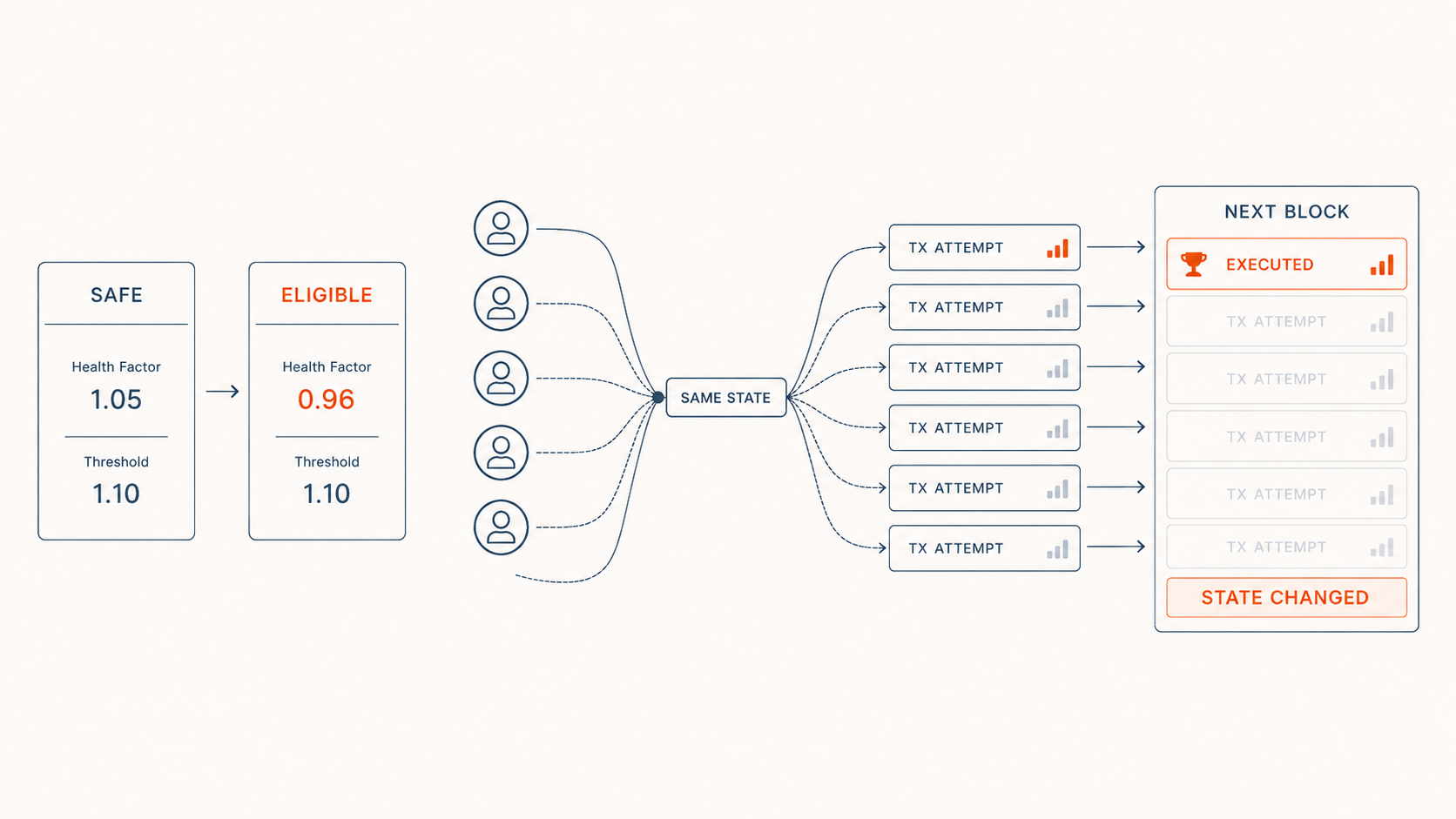
A borrower’s position on Aave, Compound, or dYdX crosses its liquidation threshold: a price oracle update lands in a block, the protocol recalculates collateral against debt, and the ratio falls below a line set in advance. From that block on, the position is liquidatable—any address that repays part of the debt can claim the collateral at a fixed-spread discount the protocol set, not one negotiated through an auction. MakerDAO is the contrasting case: it runs liquidations as auctions. This article means the fixed-spread designs.
Eligibility is no longer a forecast. It is protocol state—though not the liquidator’s net profit, which still depends on gas, slippage, available capital, routing, and whether the oracle is accurate. What changes is narrower: several liquidators can read the same public state and reach the same conclusion in the same block, while transaction ordering decides who gets access to the available liquidation capacity first. Once that capacity is claimed, later arrivals lose the discount even if they saw the same signal at the same time. Empirical work on fixed-spread liquidations finds elevated gas relative to the contemporaneous average, consistent with competitive bidding for that capacity.
Call this a common-signal execution race: the trigger for an opportunity is public, mechanically observable, and cheap to confirm, while execution, ordering, priority, and speed stay contested. Liquidators don’t need identical information—they can differ in latency, node access, inventory, or search sophistication—only the eligibility signal has to be common. Discovery has stopped being the scarce margin; claiming the discount has not.
Strip the mechanics away and normalize the available execution rent to a fixed prize R = \$100—“fixed” from here means the benchmark prize, not a liquidator’s realized profit in the wild. Ten liquidators are looking at the same hundred dollars, each wanting to be the one who claims it. Same opportunity, same crowd, different game.
Public information can still leave an execution race
My previous article modeled what happens to a market’s shared information as participation grows: the marginal contribution of another observer eventually gets small (internally the series calls this limit “post-saturation”; no real DeFi market is claimed to have reached it). This article asks a narrower, related question—once an opportunity’s trigger really is public, does the race for it disappear?
In the companion empirical piece I looked at a related empirical fact: on one Solana pool, price convergence and landed execution activity didn’t always finish at the same time. If the opportunity is held roughly fixed, how much can the execution rules themselves change the race?
Finance already has an answer, and it doesn’t require any information asymmetry. Budish, Cramton and Shim model a continuous limit-order-book market in which every firm learns that a quote is stale at the same instant—no informational head start for anyone. The race survives regardless, because the exchange still processes cancellation and execution messages one at a time; whichever message it happens to process first wins, and the loser’s identical, equally-informed order is simply late. Symmetric public information doesn’t produce a zero-rent outcome on its own—execution is serial, and priority still has to be resolved.
Aquilina, Budish and O’Neill show the same pattern in real markets. Working from exchange message data that captures failed attempts as well as successful ones—visible losers, not just winners—they find public-signal races are frequent in large-cap equities and account for a material share of trading volume even when the information itself is common. Public information does not abolish the race; it leaves priority still to be allocated.
One opportunity, two Ethereum execution venues
Onchain, the same logic shows up in how execution is architected. Qin, Zhou and Gervais hold a single blockchain-extractable-value opportunity fixed and compare two execution venues for it: the public peer-to-peer network, where a bid is a visible transaction fee, and a private relay, where a searcher submits a transaction bundle directly to a cooperating miner. They show that the mere existence of the relay channel changes how much of the opportunity gets bid away in public fees, not just who wins it—changing the execution venue changes how a fixed opportunity is allocated. I use that result as a starting point and put several mechanism families on the same retention scale.
The same paper separates opportunities exploitable from confirmed block state alone from those that still depend on a transaction pending earlier in the block. Re-execute the first kind at the top of the block and nothing changes; re-execute the second and the profit disappears. The first sits close to a common-signal opportunity; the second still involves real forecasting and observation. Roughly two-fifths of the profitable arbitrages they detect fall into that network-state category.
The historical public case is messier. Daian et al. document Ethereum bots bidding up gas fees against each other for the same arbitrage—a priority gas auction. In one instance, over a roughly \$267 opportunity, two bots went through dozens of rapid rebids in under five seconds; the winner paid about \$5 in gas, and the loser’s failed transaction was also mined and also cost gas. The loser paid something even without winning the trade. Latency kept mattering even as bidding intensified. Execution and observation never cleanly separated, even in the case built to show execution as the main event.
Three execution games, one scale
To isolate how much of that variation comes from the execution rule alone, freeze everything else: ten searchers face the same \$100 opportunity, and only the rule changes. The point is not to recreate any one protocol’s fee market. It is to put different allocation rules on one retention scale so the comparison is about the game, not about a changing prize.
Under a probabilistic benchmark, effort buys a better chance of winning without guaranteeing it. In symmetric equilibrium, aggregate outlay is
$$E_N = \frac{\alpha}{\gamma}, R \left(1 - \frac{1}{N}\right)$$
where α measures how sharply effort converts into priority and γ measures how steeply cost rises (full setup in the benchmark note below). At α=γ, outlay climbs toward the full rent as N grows; at γ=2α it never exceeds half, however large the crowd gets. Effort is costly for everyone here, win or lose—what defines the benchmark isn’t that losers escape payment, it’s that effort sets a probability rather than a deterministic rank. No real blockchain architecture in the literature reviewed here allocates execution literally this way; the benchmark’s purpose is narrower, asking what happens if effort buys a smoothly improving chance rather than a guaranteed outcome.
Under an all-pay benchmark, everyone pays their bid or effort and the highest bid deterministically wins. Aggregate outlay equals the full prize for every $N \ge 2$:
$$E_N^{\text{all-pay}} = R \quad \text{for every } N \ge 2$$
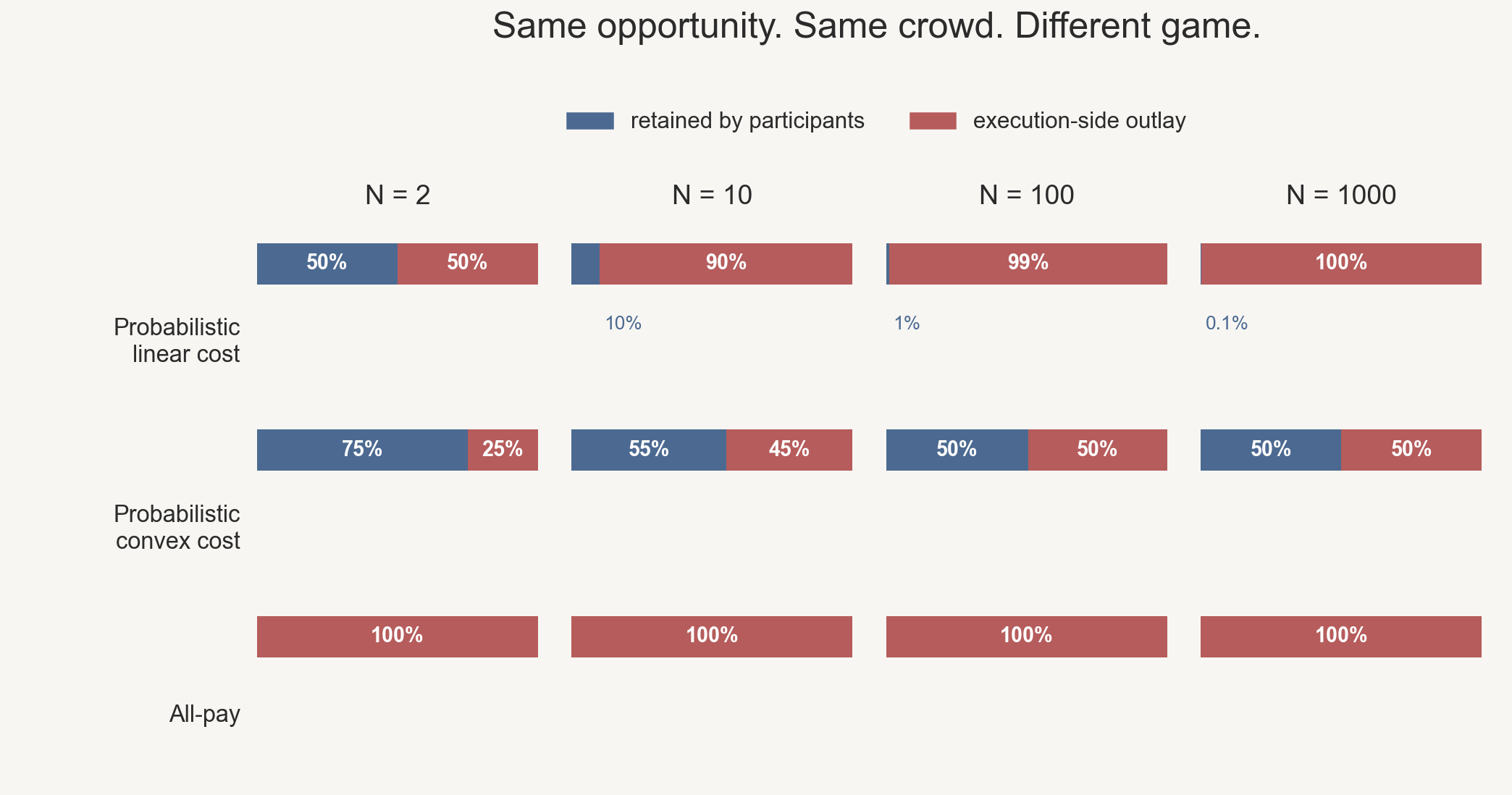
Read a column first: at N=10, the three games retain 10%, 55%, and 0% of the rent for participants—same crowd, same opportunity, a different outcome each time. That is the contrast to keep. Read a row next, and N does what you’d expect within a single game, but more slowly than switching games does.
Individual rent and the cost of entry
Aggregate outlay depends on the mechanism. What happens to any one searcher’s expected rent is a steadier story. At α=γ=1—the special case of the formula above—individual expected payoff is
$$\Pi_i = \frac{R}{N^{2}}$$
—\$25 each at two searchers, \$1 at ten, a cent at a hundred, on a \$100 opportunity. That exponent isn’t a general law; it’s what happens when priority-responsiveness and cost curvature match. Steeper costs slow the decay; under the all-pay rule, individual expected profit is exactly zero from two participants on—the floor the other curves are still falling toward. Across the benchmarks, participation compresses expected rent per searcher; the rate is mechanism-specific. Adding participants does not automatically enlarge what each one keeps.
Profit never actually reaches zero in the probabilistic benchmark—it just gets small, and small-but-positive keeps pulling entrants in. In that α=γ=1 benchmark, put a fixed cost κ on participating—running a node, keeping low-latency infrastructure, integrating with a protocol, funding a liquidation bot—and entrants keep arriving until expected profit no longer covers it:
$$N^{*} = \sqrt{R/\kappa}$$
Cut the participation cost a hundredfold and, under this continuous-N approximation, ten times as many searchers show up. κ isn’t literally one scalar cost—infrastructure gets reused across many opportunities, not sunk against one—but the direction holds: cheaper access to the race pulls in more competitors without the underlying opportunity growing at all. More participation can therefore coexist with thinner individual rent. The opportunity hasn’t grown; the queue for it has.
Where the common-signal approximation breaks
The liquidation and Ethereum-history evidence above sits toward one end of a range most onchain opportunities don’t occupy.
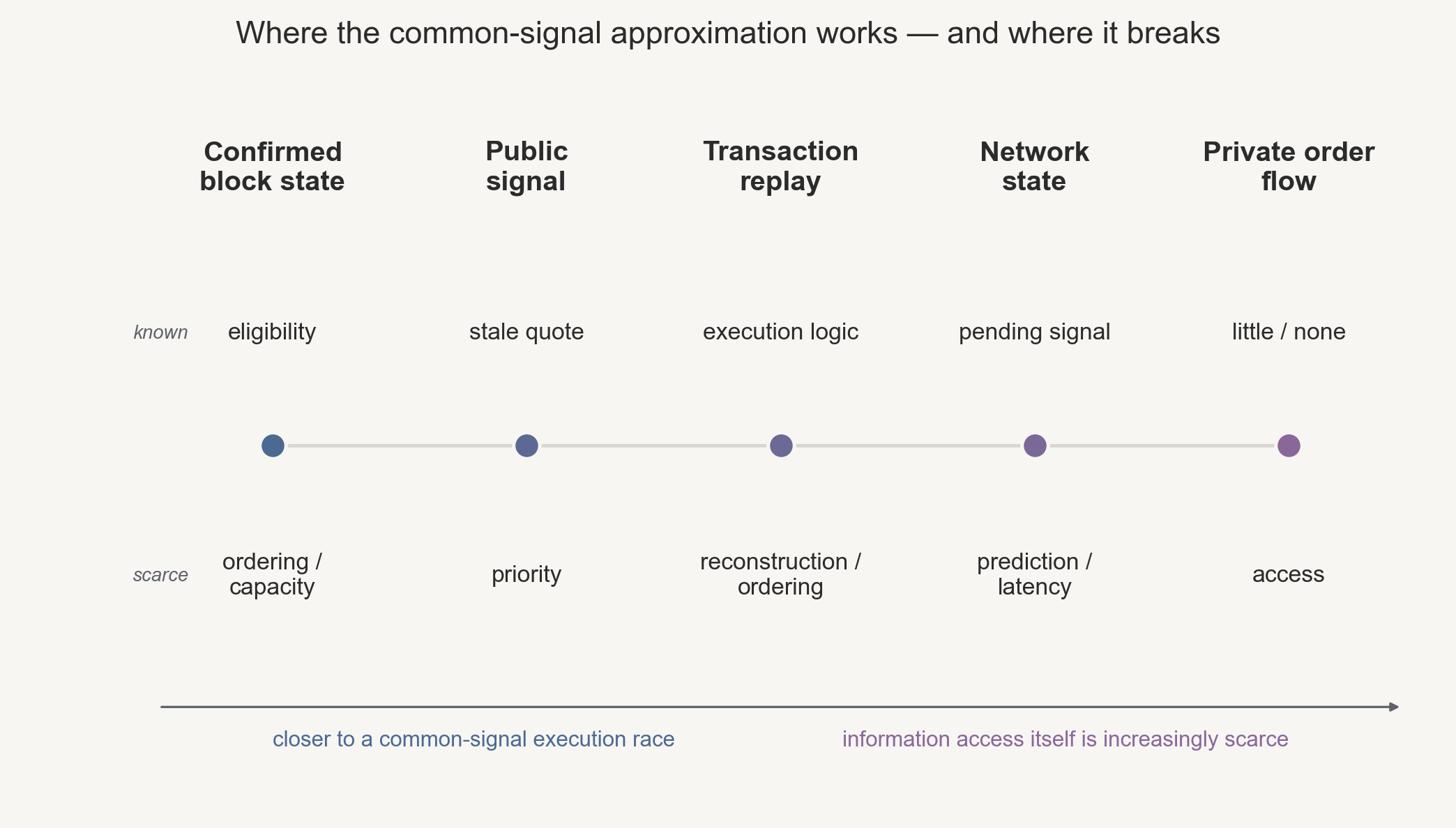
A confirmed block-state liquidation sits closest: eligibility is settled state, the discount is fixed, and what’s scarce is ordering and execution capacity. Private or exclusive order flow sits at the opposite end—the opportunity is never broadcast, so the scarce resource reverts to information access itself, and no amount of cheap execution helps a competitor who never sees the opportunity. Cases in between, including transaction replay and network-state opportunities, mix public triggers with remaining private observation. Not every MEV contest is a public-state race. The farther right you move, the less defensible the fixed, common-signal benchmark becomes.
Repeated interaction changes the effective game
Even a fixed protocol rule does not uniquely determine behavior. Daian et al. show that repeated interaction can support less aggressive bidding than the one-shot benchmark; their data are consistent with movement in that direction, though not proof of the exact equilibrium. The benchmarks above describe incentives created by execution rules, not literal predictions of bot behavior.
Holding R fixed, as every benchmark above does, intentionally removes the possibility that more participants increase the opportunity actually captured. In real markets that may be false—more liquidators or searchers can mean more inventory, geographic reach, or coverage of eligible positions, not just a thinner split of the same fixed prize. None of these benchmarks speak to social welfare, validator or builder surplus, or infrastructure reused across many opportunities: trader-side rent that doesn’t stay with a participant is not the same claim as value destroyed.
Closing
Go back to the position that crossed its threshold. The protocol made eligibility mechanical; it did not make execution simultaneous. Once several liquidators react to the same public state, the rule that allocates the discount between them stops being incidental—it decides how much of a fixed prize any one of them actually keeps. Protocol design defines the opportunity. Execution architecture helps define how the rent gets divided.
Appendix
- Benchmark setup.
- Both benchmarks assume N symmetric, risk-neutral participants, complete information, and a fixed prize R with no capacity constraint.
- Probabilistic benchmark: Tullock contest-success function $p_i = e_i^\alpha / \sum_j e_j^\alpha$, cost $c(e_i) = e_i^\gamma/\gamma$; the symmetric interior Nash equilibrium gives the $E_N$ and $\Pi_i$ formulas above, with $\Pi_i = R/N^2$ the special case at α=γ=1.
- Interior condition: the symmetric interior candidate is viable only for $\alpha \le \gamma N/(N-1)$; at the boundary its payoff falls to zero, and beyond it zero effort dominates the symmetric FOC candidate.
- Effort units are normalized, not calibrated to any real infrastructure or latency cost—α and γ are benchmark parameters, not estimates of a protocol’s actual cost structure.
- All-pay benchmark: every bidder pays regardless of outcome and the highest bid wins, with a symmetric mixed-strategy equilibrium (no pure-strategy equilibrium exists in this game).
- A winner-pays family—losers pay nothing, only the winning bid is paid—exists and maps loosely onto QZG’s relay-auction structure; its retention formula isn’t reproduced here, since making it fully auditable would take more space than the specific numbers are worth.
- References.
- Budish, E., Cramton, P., & Shim, J. (2015). The High-Frequency Trading Arms Race: Frequent Batch Auctions as a Market Design Response. The Quarterly Journal of Economics, 130(4), 1547–1621.
- Aquilina, M., Budish, E., & O’Neill, P. (2022). Quantifying the High-Frequency Trading “Arms Race.” The Quarterly Journal of Economics, 137(1), 493–564.
- Qin, K., Zhou, L., & Gervais, A. (2022). Quantifying Blockchain Extractable Value: How Dark Is the Forest? 2022 IEEE Symposium on Security and Privacy. arXiv:2101.05511.
- Qin, K., Zhou, L., Livshits, B., & Gervais, A. (2021). An Empirical Study of DeFi Liquidations: Incentives, Risks, and Instabilities. Proceedings of the 21st ACM Internet Measurement Conference. arXiv:2106.06389.
- Daian, P., Goldfeder, S., Kell, T., Li, Y., Zhao, X., Bentov, I., Breidenbach, L., & Juels, A. (2020). Flash Boys 2.0: Frontrunning, Transaction Reordering, and Consensus Instability in Decentralized Exchanges. 2020 IEEE Symposium on Security and Privacy. arXiv:1904.05234.
- Related: When More Traders Stop Adding Much Information — the companion piece this article’s opening question extends.