What Glamsterdam Would Change About Settling Korean Stocks on Ethereum
What would it cost to settle Korea Exchange’s daily trading value on Ethereum? At the baseline, block-gas capacity is not the binding constraint. Settlement architecture and new onchain state matter more.

This article models a settlement workload on Ethereum calibrated to Korea Exchange (KRX)’s reported average daily trading value, under current mainnet rules and under Glamsterdam’s proposed gas repricing. It is a gas-accounting experiment, not a proposal to move Korea’s settlement infrastructure onto Ethereum.
Capacity is not the problem at the baseline. At an assumed $10,000 average trade, settling every trade in its own transaction would use 26.0% of one day’s theoretical block gas at today’s 60-million-gas limit. That is the full-day gas ceiling, not spare capacity left after Ethereum’s existing demand, and it reaches 100% if the average trade falls to about $2,604.
Cost structure is. If clearing first nets trades so that one participant position per trade is left to update, netted settlement is 3.6× cheaper in gas than trade-by-trade settlement today, but 2.6× under Glamsterdam. Glamsterdam reprices storage writes, and new state most of all. Once netting has removed most of the settlement work, the storage created for first-time holders becomes a larger share of what remains.
1. Size the market
In an April 2025 article for the World Federation of Exchanges (WFE), KRX’s Chairman and CEO reported an average daily securities trading value of $21.34 billion (2024 data) and an 89% netting ratio. That ratio measures how much gross value clearing removes before settlement, not how many positions would remain onchain.
Dividing $21.34 billion by an assumed $10,000 average trade gives 2,134,000 trades on a representative day. Trade count is derived from value, not from KRX’s participants, instruments or settlement cycles. The share of this workload moved onchain is swept from 0% to 100%.
Trade size is the assumption that moves capacity most, because trade count scales inversely with it. Across averages of $2,000–$50,000, gross settlement with one transaction per trade needs between 130.2% and 5.2% of theoretical daily block gas at full migration. It reaches today’s ceiling at about $2,604 per trade; batching 100 trades per transaction moves that threshold to $1,598.
The workload is an average day, not transaction-level KRX records or a stress-day replay.
2. Change the settlement architecture
Both architectures leave trade matching offchain:
- Gross DvP (delivery versus payment): every trade settles atomically onchain, linking the security and cash legs. Trades can be submitted one per transaction or batched.
- Netted DvP: clearing offsets each participant’s buys against their sells offchain; each participant then settles one net position onchain per netting cycle.
Netting is easiest to see on 100 trades. Each has a buyer and a seller, so gross settlement updates 200 participant positions. If the same brokers appear on many trades, netting leaves only their net changes to write:
| Positions updated per 100 trades | Positions per trade (P/T) | Interpretation |
|---|---|---|
| 200 | 2 | Netting removes no positions |
| 100 | 1 | Netting removes half |
| 11 | 0.11 | Settlement concentrated in a few net positions |
I call this ratio P/T: net participant positions updated onchain per gross trade. All three rows are assumed scenarios, not observed KRX position counts, and KRX’s 89% value ratio does not identify P/T. Where KRX would sit depends on the account hierarchy: clearing-member or custodian accounts consolidate many trades, while end-investor settlement preserves far more positions.
To price each architecture, I measured a minimal balance-settlement contract on a local node under current mainnet rules (Prague). Holders were funded in earlier transactions; gas came from transaction receipts and was checked against opcode traces. The single-trade row is a full transaction, including intrinsic gas and calldata. For batches, the fixed overhead per transaction is separated from the incremental cost per unit, which covers that unit’s execution and calldata.
| Operation | Fixed gas per batch | Incremental gas per unit |
|---|---|---|
| Gross DvP, one trade per transaction | — | 52,722 per trade (full transaction) |
| Gross DvP, 100 trades per transaction | 23,520 | 32,116 per trade |
| Netted DvP, 200 positions per transaction | 23,012 | 14,419 per position |
A batch of 100 gross trades therefore costs 23,520 + 100 × 32,116 = 3,235,120 gas. An earlier estimate of 2,028 gas per netted participant was a test artifact: funding and settling in the same transaction made the storage writes artificially cheap.
Per position, the two architectures cost about the same: a batched gross trade costs 32,116 gas for its two positions, a netted position 14,419. Netting saves gas by eliminating positions, and by sharing transaction overhead when gross trades would otherwise each pay their own. So the size of its advantage is mostly the netting assumption:
| Positions per trade (P/T, assumed) | vs. gross, one trade/tx | vs. gross, batched | vs. gross, one trade/tx (Glamsterdam) | vs. gross, batched (Glamsterdam) |
|---|---|---|---|---|
| 0.11 | 33.0× | 20.2× | 23.8× | 19.2× |
| 1 | 3.6× | 2.2× | 2.6× | 2.1× |
| 2 | 1.8× | 1.1× | 1.3× | 1.1× |
Netting advantage: total gross gas ÷ total netted gas, with no new holders. Glamsterdam columns are modeled, not executed.
The contract settles balances only. Custody, identity and compliance checks, corporate actions, and recovery logic would each add storage reads and writes, so a production token would likely cost more per operation. The experiment also does not compare Ethereum mainnet with L2s or permissioned settlement networks.
3. Capacity at the baseline; state costs at the margin
Glamsterdam changes two things. Its repricing makes the same settlement workload heavier in gas; only a higher gas limit turns that into more headroom. And it charges far more for creating state than for updating it, which matters most to the architecture that updates the least.
The scenarios use current rules at 60 million gas per block, and Glamsterdam repricing at the same 60-million limit and at 150 million, a devnet reference rather than a scheduled mainnet limit. Glamsterdam’s mainnet activation date is unconfirmed, and no Glamsterdam EVM is executed here: the measured storage reads and writes are repriced under the proposed EIP-8037 and EIP-8038. EIP-8037 meters execution gas and state gas separately; a transaction pays for both, but each has its own block limit, so utilization follows whichever binds.
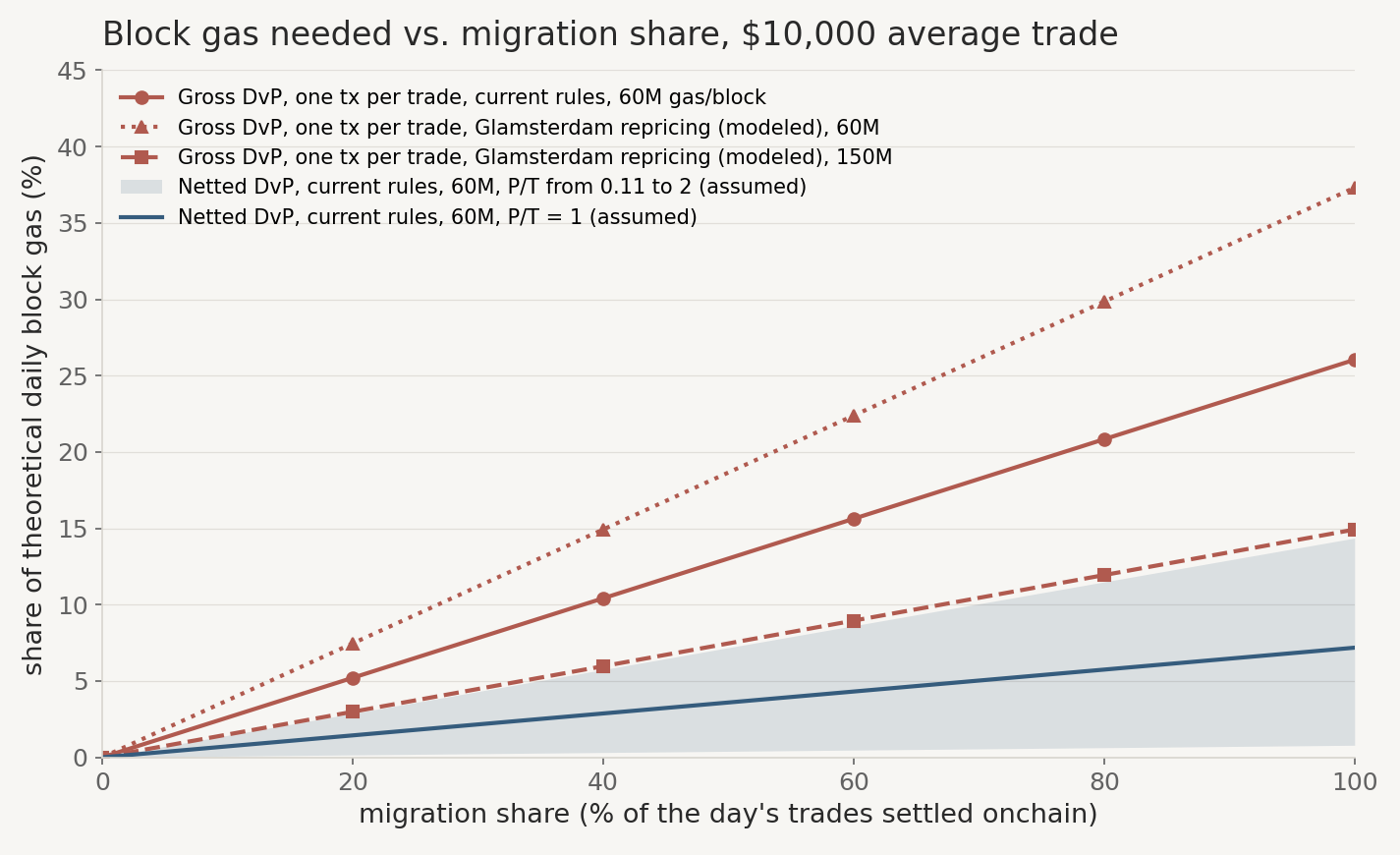
At full migration, one-transaction-per-trade gross settlement uses 26.0% of theoretical daily block gas today. Glamsterdam’s repricing alone raises that to 37.3% at the same 60-million limit; at 150 million it falls to 14.9%. Batched gross settlement uses 16.0%, 30.2% and 12.1% in the same three cases.
The repricing reaches both kinds of storage write:
- Updating an existing balance. Under EIP-8038, the first write to an existing storage slot after a balance read rises from 2,900 to 10,100 gas in this contract. A gross trade between existing holders rises from 52,722 to a modeled 75,522 gas.
- Creating a new holder. Under EIP-8037, a new storage slot costs 97,920 state gas plus 10,100 execution gas, against 20,000 gas today. The contract writes two slots per new holder, a balance and a first-holding flag, so each one adds 10,310 execution gas and 195,840 state gas under Glamsterdam, against 37,310 gas under current rules.
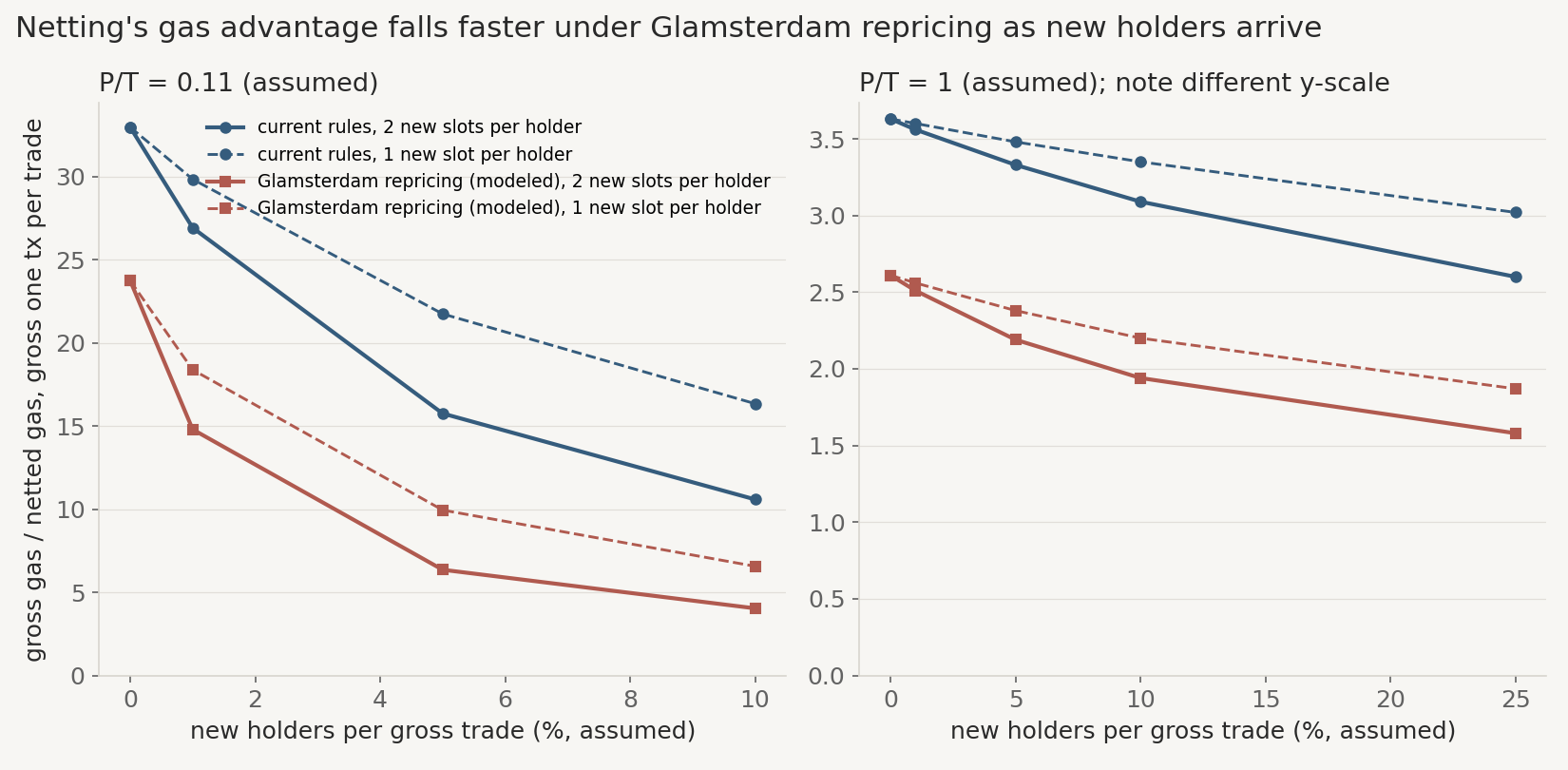
In this model, both architectures face the same new-holder population. Because netting reduces the other settlement work, new state accounts for a larger share of its remaining gas. With one position per trade, the advantage falls from 3.6× to 3.1× as new holders rise from 0% to 10% of trades today, and from 2.6× to 1.9× under Glamsterdam. With highly concentrated netting, it falls from 33.0× to 10.6× today and from 23.8× to 4.0× under Glamsterdam.
All comparisons are in gas. Dollar fees depend on gas prices, and settlement latency or failure risk depends on a system design this experiment does not model.
Closing
Under these assumptions, block-gas capacity does not stop Ethereum from settling a workload of KRX’s daily trading value; the cost of state shapes which settlement design is cheaper. Netting saves gas by reducing the positions that need updating. But when a first-time holder still needs a new onchain balance, that storage creation stays expensive under Glamsterdam’s proposed pricing. The more efficient the netting, the larger the share of its remaining cost that new holders account for. A Glamsterdam with a higher gas limit would therefore add capacity while narrowing netting’s relative gas advantage.
How far it narrows depends on two numbers this experiment had to assume: how many positions netting really leaves, and how many new holders a tokenized market brings in. The capacity result also depends on the $10,000 average trade and on batching, and the Glamsterdam figures on EIP-8037/8038 parameters that are not yet final. Participant-level netting data and an observed new-holder rate from a live tokenized-securities venue are the next measurements worth making.
Appendix
- Code and data. Gist (gas-measurement harness, Glamsterdam repricing, workload construction, and result tables).
- Fig. 2 details. Solid lines use two new slots per holder, as in the measured contract; dashed lines use one. Gross settlement is one trade per transaction, and both architectures receive the same new holders. The left panel stops at 10% because more new holders than 0.11 net positions per trade is infeasible.
- Related. What Changes When Tokenization Reaches Market Scale?