Who Pays for On-Chain Staking Yield?
Contents
Issuance, fees, MEV, and the investor's net claim.
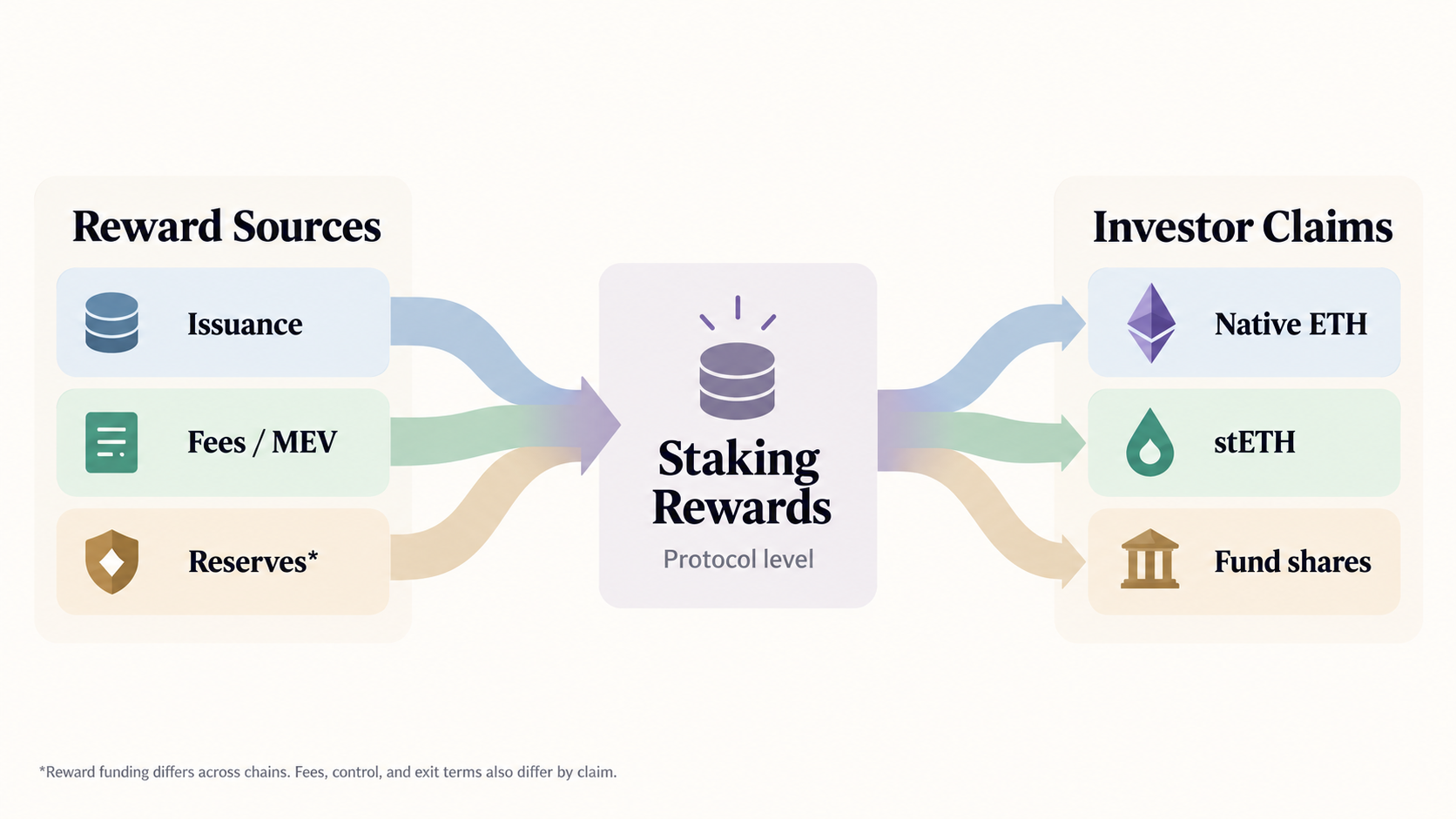
Overview. Reward sources and investor claims are separate dimensions. Fees, custody, conversion, and price risk determine the net claim.
On January 5, Grayscale said its Ethereum Staking ETF would distribute $9.4 million in cash the next day. The filing is unusually useful because it names the path. The rewards had accrued from October 6 through December 31. They were not the shareholder's gross validator rewards. Grayscale first reduced them by its staking portion, the custodian's fee, the staking provider's share, and the sponsor fee; then a liquidity provider converted the remaining amount to dollars, less further fees and expenses. The 8-K says so directly.
The headline APR is a gross protocol measure. It does not identify the investor's claim, the fee path, or the return after ETH moves.
TradFi and DeFi: What Does Yield Actually Pay For?
A bank deposit earns interest against a bank's balance sheet. A bond carries an issuer's payment obligation. Native staking works differently. Ethereum validators commit ETH to consensus and receive newly issued tokens, eligible transaction tips, and MEV-related income. There is no borrower promising a coupon.
The economics change as staking moves through intermediaries. A solo validator receives rewards in ETH but bears operating costs and protocol penalties. A Lido holder owns stETH or wstETH, with rewards reflected through rebasing balances or an exchange rate after fees. An ETHE shareholder owns a fund share, where staking income may eventually become a cash distribution after custody, provider, sponsor, and conversion costs.
BlackRock's March 2026 launch of the iShares Staked Ethereum Trust ETF makes the distinction concrete. ETHB stakes a portion of its ETH holdings and charges a 0.25% sponsor fee, temporarily reduced to 0.12% on the first $2.5 billion of assets. Its staking income varies with network conditions. The product offers market exposure and staking income, not a fixed coupon.
The same protocol reward can produce different financial claims and different net receipts. Before asking what intermediaries retain, we need to establish where the reward comes from.
Who Finances Network Security?
Ethereum validators receive newly issued ETH, user-paid priority fees, and MEV-related payments. Base fees, by contrast, are burned. Each component finances network security differently. Ethereum documentation.
Issuance changes relative ownership. Suppose stakers hold 60 of 100 tokens. If six new tokens are issued exclusively to them, their share rises to 62.3%, while non-stakers' share falls from 40% to 37.7%. The latter experience dilution, although the effect on dollar value depends on market prices.
Priority fees are paid directly by transaction users. MEV has more varied origins: arbitrage, liquidations, and adverse ordering redistribute value among different market participants. Payments from searchers and builders to proposers do not necessarily identify who ultimately bears the cost.
The financing mix also differs across chains. Solana combines inflation-funded rewards with transaction-fee income, while Hyperliquid allocates rewards from a future-emissions reserve. Economic models by Saleh, Cong, He, and Tang, and Jermann examine how such incentives connect staking participation, security, and dilution.
These mechanisms now operate at a much larger scale. Published observations place Ethereum staking at 15.9 million ETH in January 2023 and 43.8 million at the end of Q3 2026. The expanding capital base makes the distribution of staking rewards increasingly relevant to both protocol economics and intermediary businesses.
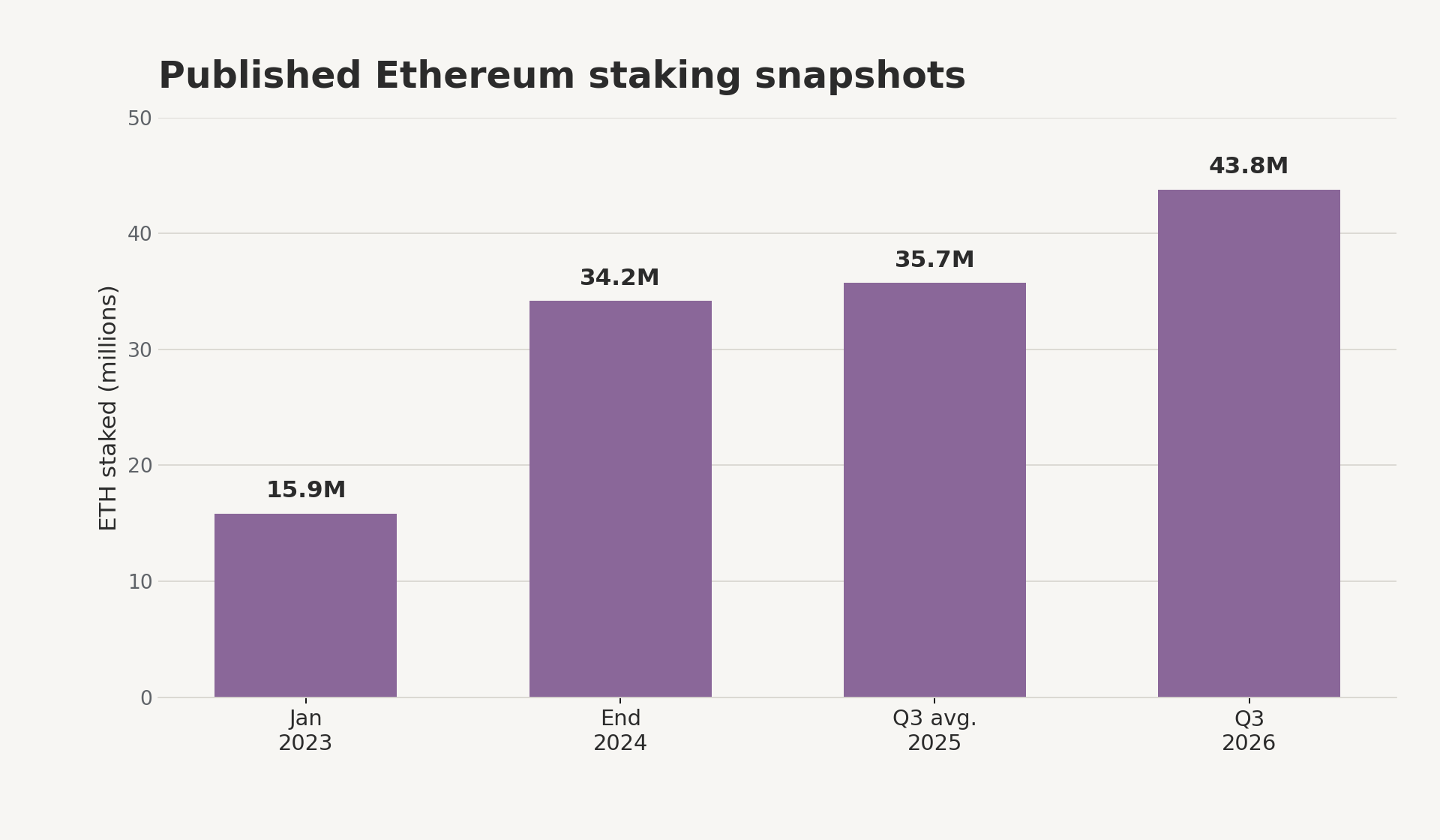
Fig. 1. Published Ethereum staking observations, 2023–2026. The data combine differently timed snapshots and reporting definitions; Q3 2025 is a period average. The 43.8m ETH endpoint is from Bitwise's October 2026 report. Frozen inputs and source definitions.
Who Captures the Economics of Staking?
Lido's H1 2026 report shows the layers between protocol rewards and an intermediary's product result. Gross rewards first accrue to the staking activity; most pass through to stETH holders. The residual becomes Lido's staking gross revenue, then net staking revenue after stated deductions, and finally a staking product result after allocated core and growth costs. The reported H1 bridge is $275.01m in gross rewards, $247.50m to stETH holders, $27.51m in gross revenue, $15.71m in net staking revenue, and a $6.73m staking product result. The unaudited report uses accrual accounting and USD translations.
From Q1 to Q2, ETH-denominated gross rewards fell 2.4%, from 62,515 ETH to 60,995 ETH. USD gross rewards fell 16.5%, net staking revenue 18.0%, and staking product result 41.6%. Product margin—product result divided by net staking revenue—fell from 49.2% to 35.0%.
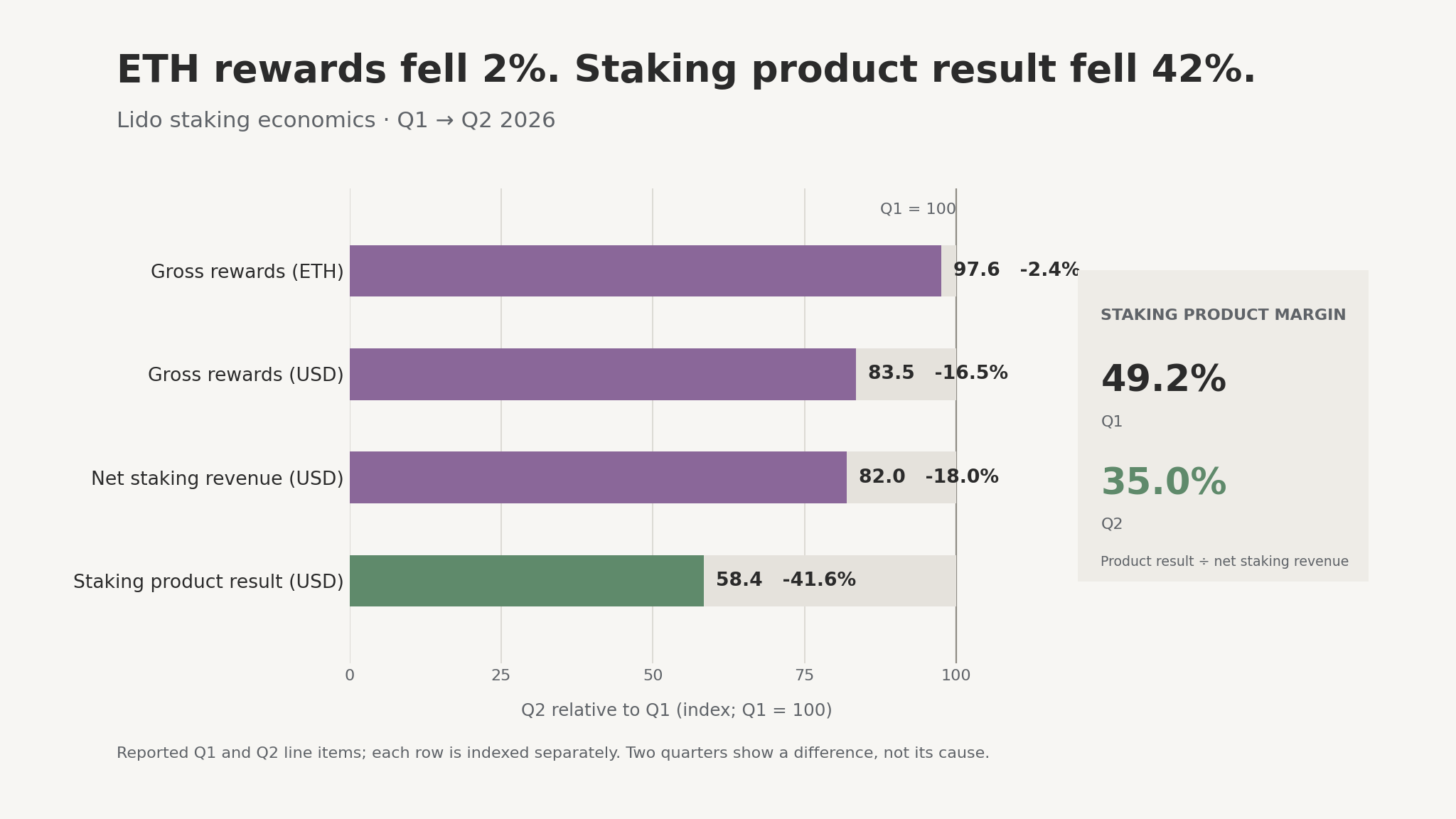
Fig. 2. Each series is normalized independently to its Q1 2026 value of 100. Staking product result fell from $4.25m to $2.48m. The two-quarter comparison does not identify whether ETH/USD, cost allocation, revenue sharing, or another factor caused the margin change; product margin is not consolidated DAO profitability or investor return.
The result fell $1.77 million: net staking revenue fell $1.55 million and product costs rose $0.22 million. Lido says the ETH-price decline reduced Q2 USD revenue. The accounts do not allocate the remainder among price, revenue sharing, cost allocation, or operating leverage. The narrow finding is enough: stable token-denominated rewards did not produce stable USD intermediary profitability.
H1 also changed Lido's relative position. Total ETH staked rose from approximately 36.3 million to 43.1 million, but Lido accounted for 5.7% of reported net growth. Institutional staking's share rose from 25.9% to 35.3%, while Lido's share fell from 23.93% to 21.18%. Market growth did not translate into proportionate growth for the incumbent liquid-staking intermediary.
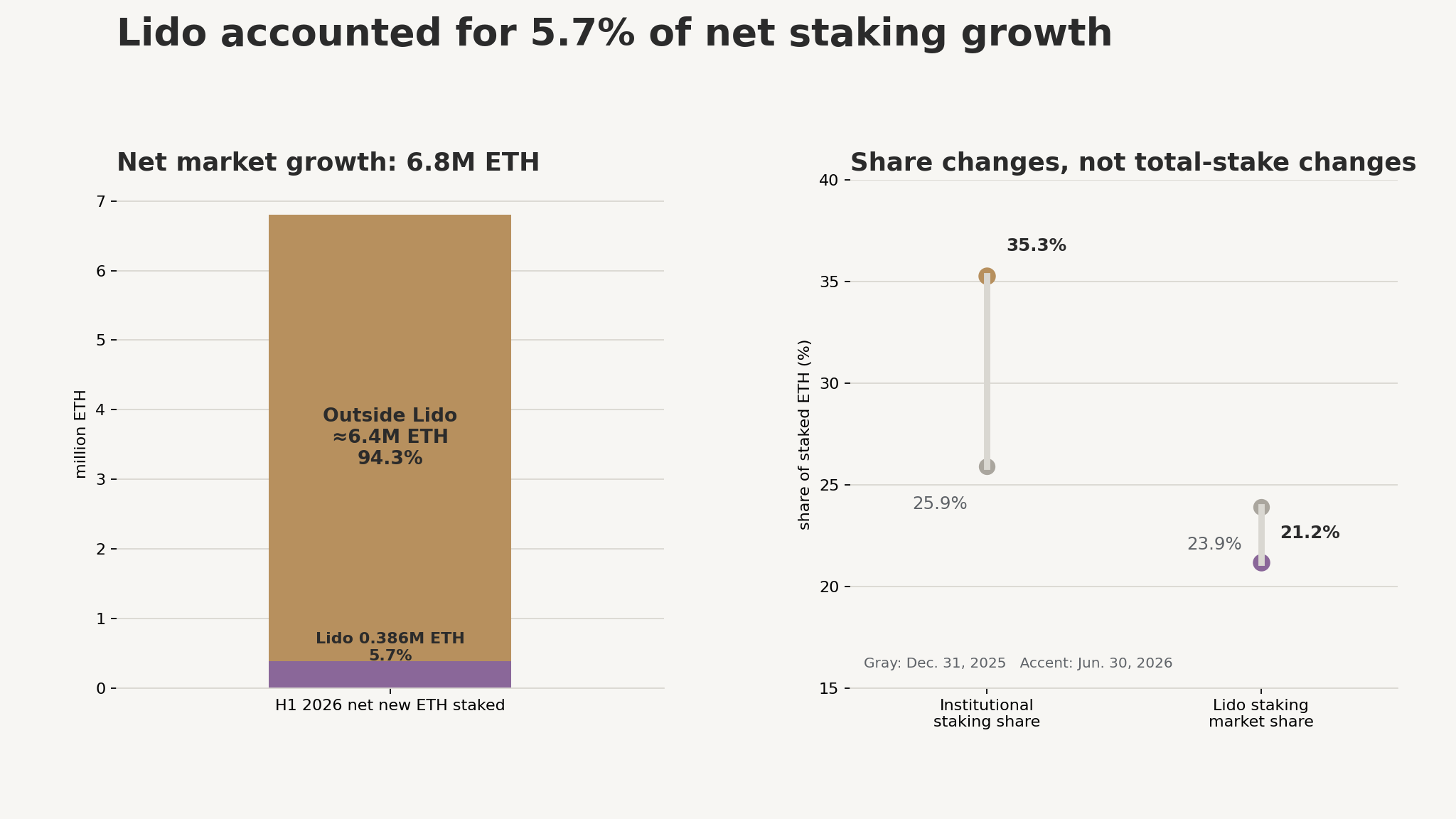
Fig. 3. Lido accounted for 5.7% of Ethereum's reported net staking growth in H1 2026. Panel A uses end-period stake changes; its approximately 6.4m ETH non-Lido residual is not a flow trace or an institutional proxy. Panel B shows separate share changes, not total-stake changes, and does not establish migration or causality.
When Staking Enters the Financial System
Grayscale shows how protocol rewards become fund income. ETHE receives staking rewards after applicable fees and may convert them into cash distributions. In H1 2026, six distributions totalled $21.15 million, or $0.196777 per share, according to its Form 10-Q.
A cash distribution is not an additional return on top of the underlying staking income. All else equal, distributing cash reduces the fund's NAV by a corresponding amount. Staking generates rewards; distribution changes how shareholders hold that value.
Regulation has also evolved. The SEC's 2025 staking statements were nonbinding staff views. In March 2026, the Commission issued an interpretation covering specified protocol-staking and staking-receipt arrangements, superseding earlier statements on those topics while preserving Howey. It does not address restaking or materially different arrangements involving discretionary staking decisions or guaranteed rewards.
Institutional access therefore changes more than the payout format. Custody, fees, withdrawal rights, and control over staking decisions become part of the investor's financial claim. Those terms determine how much of the protocol reward reaches the shareholder—and under what conditions.
Closing
Ethereum shows a security budget with several funding channels: issuance, priority fees, and ordering income. Lido shows that those rewards can pass through an intermediary whose USD product result moves more than token-denominated receipts. Its H1 market data also show that a growing staking market need not expand an incumbent's share. Grayscale shows the final step: a shareholder owns a fund claim with fees, conversion, distributions, and NAV mechanics—not a protocol APR. That is the economic object a financial product needs to disclose.
Appendix
- Main-figure sources. Lido H1 2026 accounting and market snapshots · Grayscale H1 2026 Form 10-Q · Ethereum issuance.